
Historic Milestone: NASA Artemis II Rocket Reaches Launch Pad
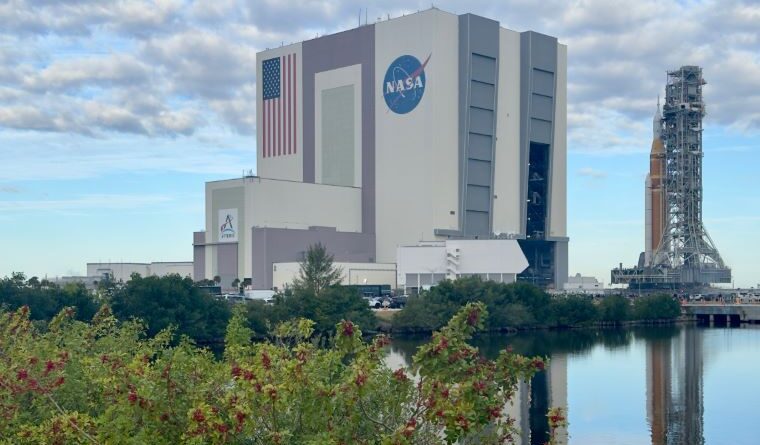
NASA has achieved a major milestone in NASA Artemis II lunar exploration program as the Artemis II rocket and Orion spacecraft were successfully rolled out to Launch Pad 39B at the Kennedy Space Center in Florida on January 17, 2026. The event marks a crucial step toward the first crewed mission around the Moon in more than 50 years, signaling a new era of human deep-space exploration.
The towering Space Launch System (SLS) rocket, standing approximately 322 feet tall, was transported from the Vehicle Assembly Building to the launch pad during a carefully controlled journey that took nearly 12 hours. The four-mile rollout was conducted using NASA’s massive crawler-transporter, moving at less than one mile per hour to ensure the safety and stability of the fully assembled rocket.
With the rocket now positioned at the launch pad, NASA teams have begun final preparations, including system integrations, safety checks, and countdown rehearsals. A key upcoming milestone is the wet dress rehearsal, during which the rocket will be fully fueled and a complete launch countdown will be practiced. This test is essential for verifying procedures and ensuring all systems perform as expected before astronauts are cleared to fly.
First Crewed NASA’s Artemis II Mission
Artemis II will carry a four-member crew on an approximately 10-day mission that will take them beyond low-Earth orbit, loop around the Moon, and return safely to Earth. The crew includes Commander Reid Wiseman, Pilot Victor Glover, Mission Specialist Christina Koch, and Mission Specialist Jeremy Hansen of the Canadian Space Agency.
This mission will be the first time humans travel into deep space since Apollo 17 in 1972. Unlike future Artemis missions, Artemis II will not land on the lunar surface. Instead, it will test the Orion spacecraft’s life-support systems, navigation, communications, and overall performance in the deep-space environment while carrying astronauts.
Countdown to Launch
NASA is targeting an early 2026 launch, with specific dates dependent on technical readiness, weather conditions, and orbital mechanics. Multiple launch windows are planned to allow flexibility in case additional testing or adjustments are required.
Once launched, the mission will provide critical data needed to validate systems and procedures for upcoming lunar landing missions. The success of Artemis II is considered essential before proceeding with Artemis III, which aims to land astronauts on the Moon for the first time since the Apollo era.
A Step Toward the Future
Artemis II represents more than a single mission—it is a key building block in NASA’s long-term strategy to establish a sustained human presence on the Moon and prepare for future crewed missions to Mars. By returning humans to lunar space, NASA is laying the foundation for deeper exploration of the solar system and advancing international cooperation in space.
As final preparations continue at Kennedy Space Center, Artemis II stands as a powerful symbol of humanity’s renewed commitment to exploring beyond Earth and pushing the boundaries of what is possible in space.