
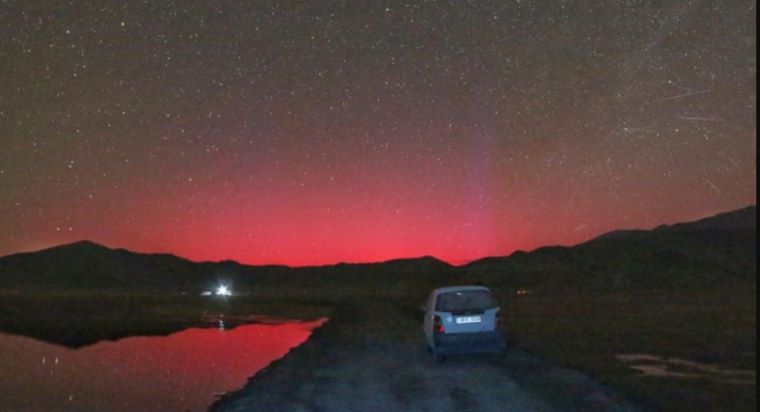
Ladakh Sky Turned Blood-Red: Rare Auroras Indicate Powerful Solar Storm
In a spectacular and rare celestial event, the night Ladakh sky over Hanle in Ladakh turned a deep blood-red colour on the nights of January 19 and 20, 2026, astonishing locals, astronomers and skywatchers across India. The normally dark, pristine skies of the Hanle Dark Sky Reserve — renowned for clear astronomical observation — were transformed into a vivid crimson display, a sight rarely seen so far from the polar regions.
Scientists say the dramatic red glow was caused by auroral activity triggered by intense solar weather, not simply atmospheric pollution or optical illusion. Auroras — usually confined near Earth’s poles — occur when charged particles from the Sun interact with Earth’s magnetic field and upper atmosphere. In this case, exceptionally powerful solar activity sent a massive burst of high-energy particles toward Earth, igniting oxygen atoms high above the surface and producing red light instead of the more common green aurora.
What Triggered the Red Sky?
The red auroras were linked to a major solar event earlier in mid-January, where the Sun emitted a strong X-class solar flare — the most intense category of solar outburst. This flare drove a Coronal Mass Ejection (CME) — a huge cloud of magnetized plasma — toward Earth. When this cloud struck Earth’s magnetic shield, it caused a severe geomagnetic storm.
During such storms, highly energetic particles are funnelled along magnetic field lines into the upper atmosphere. When these particles collide with atoms of oxygen and nitrogen at altitudes of several hundred kilometres, the atoms release energy as light. At high altitudes, oxygen can emit red auroral hues, which is what was seen over Ladakh.
Why This Event Is Rare
Auroras are typically observed near the polar regions because Earth’s magnetic field directs charged solar particles toward the poles. Seeing auroral activity — especially red auroras — as far south as Ladakh is highly unusual, and is considered a rare occurrence unless solar storms are particularly intense. The all-sky cameras at the Hanle observatory captured this unusual display, making it one of the rarest auroral observations in India in recent years.
Beyond Beauty: A Warning Sign
While the glowing red sky was visually stunning, scientists and space weather experts have emphasised that this was not just a beautiful phenomenon but a warning sign:
Space Weather Impacts
- Strong geomagnetic storms, like the one that produced these auroras, can disrupt satellite operations, GPS navigation and communication systems.
- They can also affect power grids on Earth and increase radiation exposure for satellites and high-altitude flights.
- Such events occur more frequently as the Sun approaches the peak of its 11-year activity cycle, meaning solar weather monitoring is crucial.
Scientists say that this phenomenon highlights the importance of space weather forecasting and monitoring missions, which help in preparing for and mitigating the effects of powerful solar storms on Earth’s technological infrastructure.
How Locals and Experts Reacted
The unusual crimson glow drew attention on social media and among scientific communities. Many shared stunning images and time-lapse videos of the red auroras over Ladakh’s high-altitude skies. Astronomers and space scientists noted both the scientific significance and the rare nature of the event, as well as the need to communicate how space weather can impact daily life far beyond just spectacular sky views.
Conclusion
The blood-red sky seen over Hanle, Ladakh in January 2026 was not merely a stunning natural spectacle — it was the result of intense solar activity and a strong geomagnetic storm, producing rare auroras normally seen only near the polar regions. While breathtaking, the event also serves as a reminder of the dynamic relationship between the Sun and Earth, and the potential impacts of space weather on modern technology and infrastructure.