
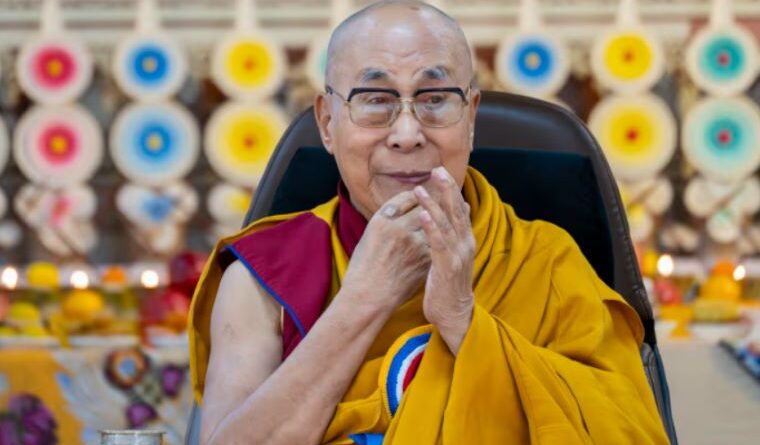
Dalai Lama Wins First Grammy at 90, China Condemns Honour as ‘Political Manipulation’
Tenzin Gyatso, the 14th Dalai Lama, has won his first Grammy Award at the age of 90, receiving the honour in the Best Audio Book, Narration and Storytelling Recording category at the 68th Annual Grammy Awards. The award was given for his spoken-word album Meditations: The Reflections of His Holiness the Dalai Lama, which features his reflections on peace, compassion, mindfulness, and universal responsibility, delivered through narration and accompanied by music.
The Dalai Lama described the recognition as a reminder of humanity’s shared responsibility and accepted it with gratitude and humility. The award was accepted on his behalf at the ceremony in Los Angeles, highlighting the global appeal of his teachings that extend beyond religious boundaries and resonate with a wide international audience.
Strong Reaction from China
The Chinese government reacted sharply to the Grammy win, condemning the award and calling it an act of political manipulation. Chinese officials claimed the recognition was being used to promote anti-China sentiment and reiterated their long-standing position that the Dalai Lama is a political exile involved in separatist activities under the cover of religion.
China stated that it firmly opposes the use of international platforms, cultural honours, or awards to support what it considers anti-China political agendas. The Chinese Foreign Ministry again asserted that the Dalai Lama is not merely a religious leader but someone they accuse of pursuing separatist goals.
Background Context
The Dalai Lama has lived in exile in India since 1959, after fleeing Tibet following a failed uprising against Chinese rule. China considers Tibet an integral part of its territory and has remained in conflict with the Dalai Lama over issues of political authority, cultural autonomy, and religious leadership.
Another major point of contention is the question of the Dalai Lama’s succession. While China insists that any future successor must be approved by its government, the Dalai Lama has stated that his successor will be born outside Chinese control, further intensifying tensions.
Dalai Lama’s Response
In response to the honour, the Dalai Lama emphasised that he does not view the Grammy Award as a personal achievement. Instead, he described it as recognition of the values he has promoted throughout his life—peace, compassion, non-violence, environmental responsibility, and the unity of humanity. He expressed hope that the award would help spread these messages across the world.
Significance of the Award
The Grammy win is significant as it marks a rare instance of a spiritual leader being recognised by a major global entertainment institution. It reflects the enduring influence of the Dalai Lama’s message and its relevance in contemporary global discourse.
At the same time, China’s strong response highlights the deep political sensitivities surrounding his global recognition and underscores the ongoing geopolitical tensions related to Tibet’s identity, autonomy, and spiritual leadership.