
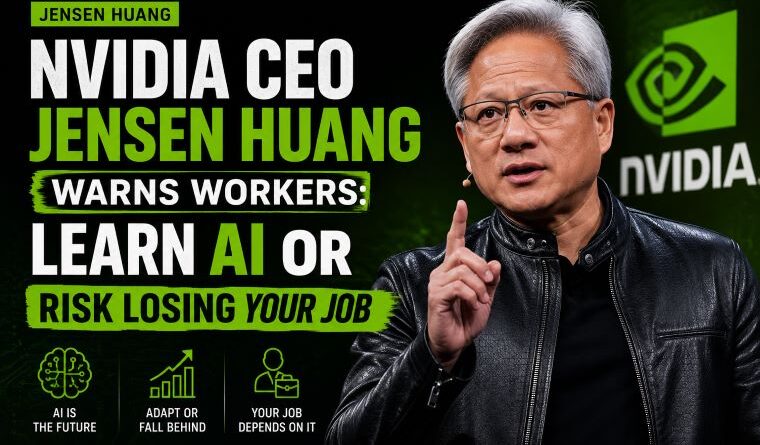
Nvidia CEO Jensen Huang Warns Workers: Learn AI Or Risk Losing Your Job
Nvidia CEO Jensen Huang has issued a strong warning about the future of jobs in the artificial intelligence era, saying employees across industries could risk losing their jobs if they fail to adapt to AI technologies.
His remarks have sparked global discussions about how rapidly artificial intelligence is reshaping the workforce and changing the skills needed for future careers.
What Did Jensen Huang Say?
Jensen Huang reportedly emphasized that workers who do not learn how to use AI tools may struggle in the future job market.
According to reports, he suggested:
- AI will transform nearly every profession
- Workers must learn to collaborate with AI
- Productivity expectations will increase rapidly
- Employees who ignore AI could become less competitive.
His comments reflect growing concerns across industries as companies increasingly automate tasks using generative AI systems.
“AI Won’t Take Your Job — Someone Using AI Will”
One of the most widely discussed ideas in the AI debate is that:
AI may not directly replace workers, but workers using AI could replace those who do not.
This concept aligns closely with Huang’s recent comments and reflects how businesses are prioritizing efficiency and automation.
Experts believe AI is becoming a productivity multiplier that allows smaller teams to complete larger workloads faster.
AI Is Changing Every Industry
Artificial intelligence is no longer limited to technology companies alone.
AI tools are now being used in:
- Finance
- Healthcare
- Education
- Marketing
- Customer service
- Manufacturing
- Logistics
- Software development
to automate repetitive tasks and improve decision-making.
Companies worldwide are investing billions into AI systems to reduce costs and improve productivity.
Skilled Trade Workers May Benefit More
Interestingly, Huang also reportedly highlighted that certain skilled trade professions could remain highly valuable in the AI era.
He mentioned careers such as:
- Electricians
- Plumbers
- Iron workers
- Skilled technicians.
These jobs often require:
- Physical work
- Real-world problem solving
- On-site decision making
which remain difficult for AI systems and robots to fully automate.
Why Tech Leaders Are Warning About AI Disruption
Major technology executives increasingly believe AI could reshape employment patterns globally.
Companies are already using AI for:
- Writing code
- Data analysis
- Customer support
- Content generation
- Administrative tasks
- Research assistance
This has created fears around:
- Job displacement
- Hiring slowdowns
- Reduced entry-level opportunities
especially in white-collar industries.
AI Could Increase Work Pressure Too
Some experts argue AI may not reduce workloads as much as expected.
Instead, AI tools could:
- Raise productivity expectations
- Increase output demands
- Accelerate workplace competition
- Push employees to work faster.
As automation improves efficiency, companies may expect workers to deliver more in less time.
Why Nvidia Is Central To The AI Boom
Nvidia has become one of the most important companies in the AI industry because its advanced chips power many modern AI systems.
Its technology is widely used for:
- AI training
- Data centers
- Machine learning
- Autonomous systems
- Generative AI models
The global AI boom has dramatically increased demand for Nvidia’s hardware in recent years.
What Skills Could Become Most Important?
Experts increasingly recommend learning:
- AI tools and workflows
- Data literacy
- Critical thinking
- Problem-solving
- Communication skills
- Human-AI collaboration
rather than relying only on traditional technical skills.
Workers who understand how to use AI effectively may gain significant career advantages.
Will AI Completely Replace Humans?
Most analysts believe AI will not fully replace human workers in the near future.
However, AI is expected to:
- Change job roles
- Reduce repetitive work
- Automate routine tasks
- Shift skill requirements
Human strengths such as:
- Creativity
- Leadership
- Emotional intelligence
- Strategic thinking
- Ethics
are still considered difficult for AI systems to replicate fully.
Growing Global Debate Around AI Jobs
Governments, businesses, and universities worldwide are now debating:
- How to prepare workers for AI disruption
- Which industries are most vulnerable
- How education systems should evolve
- Whether AI regulations are needed
Many experts believe future workers will need continuous upskilling to remain competitive.
Conclusion
Jensen Huang’s warning reflects a major shift happening across the global workforce as artificial intelligence rapidly transforms industries and job expectations.
While AI may not eliminate all jobs, experts increasingly believe workers who learn to use AI effectively could have a significant advantage over those who resist technological change.
As companies continue investing heavily in automation and AI tools, adaptability and continuous learning are likely to become essential skills for the future economy.