
NASA’s Curiosity Rover Finds Vast Honeycomb-Like Terrain on Mars
NASA’s Curiosity rover has made another fascinating discovery on the Red Planet—a vast landscape covered with honeycomb-like polygonal patterns unlike anything it has previously observed. The unusual terrain, described as a “sea of polygons,” could provide important clues about Mars’ ancient climate, geological history, and the possible presence of water billions of years ago.
The discovery was made as Curiosity continued exploring the foothills of Mount Sharp inside Gale Crater, where it has been conducting scientific investigations since landing on Mars in 2012. Scientists believe these newly discovered formations may help answer long-standing questions about how the Martian surface evolved over time.
What Did Curiosity Discover?
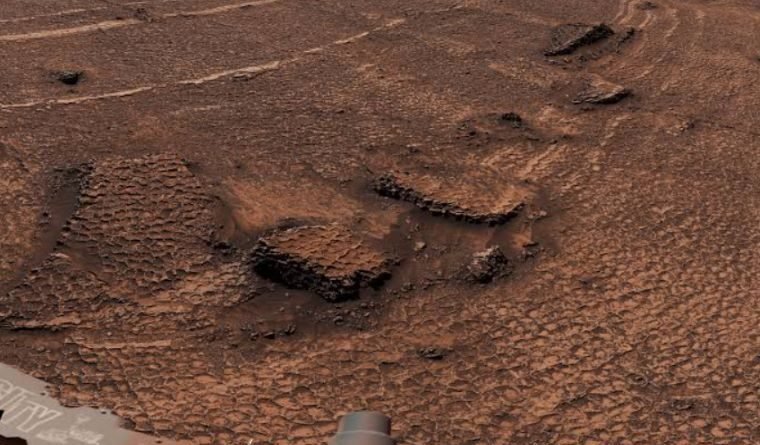
Curiosity captured a 360-degree panoramic image showing an enormous field of polygonal fractures stretching in every direction across a valley known as Valle Grande.
Unlike earlier observations, where similar formations appeared only in small isolated patches, this discovery covers an extensive area, making it the largest collection of polygonal textures ever recorded by the rover. Each polygon measures roughly 4 to 8 centimeters (1.5 to 3 inches) across and creates a striking honeycomb-like appearance on the Martian surface.
Why Are These Honeycomb Patterns Important?
Scientists are particularly interested because these polygonal structures may preserve evidence of ancient environmental conditions on Mars.
Several possible explanations are being investigated:
- Drying and cracking of ancient mud after water evaporated.
- Repeated cycles of heating and cooling over millions of years.
- Compression of sediments that forced water out of underground layers.
- Other geological processes that shaped the Martian landscape.
Researchers hope that studying the size, chemistry, and arrangement of these polygons will help determine exactly how they formed.
Could This Be Evidence of Ancient Water?
One of the leading theories links the formations to Mars’ wetter past.
Billions of years ago, scientists believe lakes and streams flowed around Mount Sharp, creating environments that were dramatically different from today’s cold, dry planet. If the honeycomb-like fractures are indeed ancient mud cracks, they could represent another piece of evidence that liquid water once existed in the region.
Although the discovery does not prove that life once existed on Mars, it strengthens the case that the planet once had conditions capable of supporting liquid water.
Where Was the Discovery Made?
The formations were found in Valle Grande, a valley along Curiosity’s route as it climbs Mount Sharp, the central mountain inside Gale Crater.
Curiosity recorded the panorama during Martian sols 4,930 and 4,931 (June 19–20, 2026). The polygonal textures even extend around a nearby butte nicknamed “Miraflores,” demonstrating how widespread the unusual terrain is.
Scientists Are Still Solving the Mystery
Despite the exciting discovery, researchers have not yet reached a final conclusion about how the formations developed.
Mission scientists are now:
- Examining the chemical composition of the rocks.
- Measuring the shapes and spacing of the polygons.
- Comparing them with similar geological formations on Earth.
- Looking for additional evidence of ancient water activity.
The data collected by Curiosity may help distinguish between competing theories about the origin of these remarkable patterns.
Curiosity’s Continuing Mission
Curiosity landed on Mars in August 2012 as part of NASA’s Mars Science Laboratory mission.
Originally designed for a two-year mission, the rover has remained operational for nearly 14 years and continues to make significant discoveries about Mars’ geology and climate.
Its primary goals include:
- Studying ancient environments.
- Searching for signs that Mars could once have supported microbial life.
- Understanding the planet’s geological evolution.
- Helping prepare for future robotic and human exploration.
Why This Discovery Matters
The newly discovered honeycomb-like terrain demonstrates that Mars still holds many geological mysteries waiting to be explored.
By understanding how these polygonal fractures formed, scientists hope to reconstruct Mars’ environmental history and better understand how the planet transformed from one that may have hosted rivers and lakes into the cold, arid world we see today.
Each new discovery by Curiosity brings researchers one step closer to answering one of humanity’s biggest questions: Was Mars ever capable of supporting life?
Conclusion
NASA’s Curiosity rover has uncovered one of the most intriguing geological formations ever seen on Mars—a vast field of honeycomb-like polygonal textures stretching across Valle Grande. While scientists are still investigating how these formations developed, they may offer valuable clues about the Red Planet’s ancient climate, water history, and geological evolution. As Curiosity continues its historic mission, discoveries like this remind us that Mars still has many secrets left to reveal.
Frequently Asked Questions (FAQs)
1. What did NASA’s Curiosity rover discover on Mars?
Curiosity discovered a vast field of honeycomb-like polygonal fractures, described as a “sea of polygons,” in a Martian valley called Valle Grande.
2. Why are the honeycomb-like patterns important?
Scientists believe the formations could reveal important information about Mars’ geological history and may indicate ancient environmental processes involving water.
3. Could the discovery prove that water once existed on Mars?
Not by itself. However, the polygonal formations are consistent with features that can form in wet sediments, adding to previous evidence that ancient Mars once had lakes and streams.
4. Where were the formations found?
They were discovered in Valle Grande, near Mount Sharp inside Gale Crater, where Curiosity has been exploring for years.
5. How long has Curiosity been exploring Mars?
Curiosity landed on August 6, 2012, and has continued operating well beyond its original mission, making groundbreaking discoveries about Mars for nearly 14 years.
6. Have scientists determined how the honeycomb patterns formed?
No. Researchers are still analyzing their chemistry, shape, and surrounding geology to determine whether they formed through drying mud, temperature cycles, sediment compression, or other geological processes.