
Independence Day 2026: Why India Celebrates August 15, Midnight Independence Story and 80th Independence Day
Independence Day 2026: India is celebrating its 80th Independence Day on August 15, 2026, marking 79 years since the country became independent from British rule in 1947. The day is observed as a tribute to the freedom fighters whose sacrifices helped India achieve independence and as a reminder of the country’s journey since then.
This year’s celebrations also focus on “Yuva Shakti for Viksit Bharat@2047”, highlighting the role of young Indians in building a developed India by 2047.
Why is Independence Day celebrated on August 15?
India became independent from British rule on August 15, 1947.
The date was formally established through the Indian Independence Act, 1947, which provided for the creation of the independent dominions of India and Pakistan. According to historical accounts, Lord Mountbatten selected August 15 as the date for the transfer of power.
Since then, August 15 has been observed every year as India’s Independence Day.
Why did India get independence at midnight?
One of the most frequently asked questions about India’s independence is why the transfer of power happened around midnight on August 14-15, 1947, rather than during the daytime.
Historical and popular accounts connect the timing to both political circumstances and contemporary astrological considerations.
Mountbatten had already selected August 15, partly because the date had personal significance for him following Japan’s surrender in 1945. Once the date was fixed, changing it was difficult.
According to the astrology-based account, Indian astrologers were concerned about the suitability of August 15 and looked for an auspicious time within the fixed date. Midnight provided a window in which the new date had begun while an astrologically favourable Vrishabha (Taurus) Lagna was said to be rising in Delhi.
It is important to note that the astrological explanation is a traditional account and should not be confused with the legal and historical reasons for the transfer of power.
What happened on the night of August 14, 1947?
As midnight approached, the Constituent Assembly met in New Delhi.
Jawaharlal Nehru delivered his historic “Tryst with Destiny” speech as India prepared to enter a new era as an independent nation.
At midnight, British rule formally ended and India became an independent country.
The occasion represented the culmination of decades of political movements, protests, imprisonment and sacrifices by countless freedom fighters.
Who were the major freedom fighters?
India’s independence movement involved thousands of people across different regions and political movements.
Some of the most widely remembered figures include:
- Mahatma Gandhi
- Subhas Chandra Bose
- Bhagat Singh
- Chandrashekhar Azad
- Jawaharlal Nehru
- Sardar Vallabhbhai Patel
- Bal Gangadhar Tilak
- Sarojini Naidu
- Lala Lajpat Rai
- Annie Besant
Many other known and unknown Indians also contributed to the freedom struggle.
DD News describes Independence Day as an occasion to remember the sacrifices of both known and unknown freedom fighters.
Where is the main Independence Day celebration held?
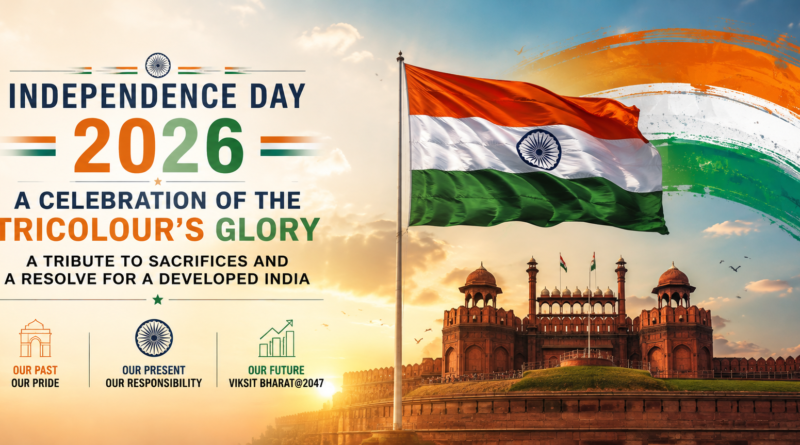
The main national Independence Day ceremony takes place at the Red Fort in New Delhi.
The Prime Minister hoists the national flag from the Red Fort and addresses the nation.
The ceremony has become one of India’s most important annual national events, combining remembrance of the freedom struggle with discussion of India’s present challenges and future goals.
What is special about Independence Day 2026?
Independence Day 2026 is significant because India is celebrating its 80th Independence Day.
The year’s central theme places particular emphasis on India’s youth and the goal of building a Viksit Bharat by 2047, when the country will complete 100 years of independence.
Another notable feature is the commemoration of 150 years of Vande Mataram, with special attention to the national song during the celebrations.
What does the Tricolour represent?
The Indian national flag, or Tiranga, is one of the strongest symbols associated with Independence Day.
The flag consists of three horizontal colours:
- Saffron at the top
- White in the middle
- Green at the bottom
- The Ashoka Chakra at the centre
During Independence Day celebrations, the Tricolour is displayed across schools, government buildings, homes, public spaces and institutions throughout the country.
It represents India’s journey from the freedom struggle to independence and its continuing commitment to democracy and development.
What is the significance of Vande Mataram in 2026?
The year 2026 marks 150 years of Vande Mataram.
The song became closely associated with India’s freedom movement and the expression of national consciousness.
According to DD News, the 2026 Independence Day celebrations give special importance to its collective singing, connecting the song’s historical legacy with the present generation.
What does Independence Day mean for today’s generation?
Independence Day is not only about remembering India’s past.
It is also an opportunity to think about the country’s future.
Issues such as technology, education, innovation, employment, national security, environmental sustainability and economic development are increasingly important as India looks toward 2047.
DD News highlights areas such as artificial intelligence, digital technology, space, semiconductors, green energy and advanced manufacturing as important areas for India’s future.
Why is youth important for Viksit Bharat 2047?
Young Indians are expected to play an important role in India’s development over the next two decades.
The 2026 Independence Day theme, “Yuva Shakti for Viksit Bharat@2047,” puts youth participation at the centre of the national vision.
Education, skills, entrepreneurship, innovation and responsible citizenship can all contribute to India’s development as the country approaches 100 years of independence.
Independence Day 2026 Wishes
People across India also celebrate the day by exchanging Independence Day wishes, messages and greetings.
Some simple wishes include:
“Happy Independence Day 2026! Let us remember the sacrifices of our freedom fighters and work together for a stronger and better India.”
“May the Tricolour always inspire us to stand united and contribute to the progress of our nation. Happy Independence Day!”
“On this Independence Day, let us honour our past and work towards a developed India by 2047.”
Independence Day 2026: Key Facts
| Detail | Information |
| Date | August 15, 2026 |
| Occasion | India’s Independence Day |
| Year of independence | 1947 |
| Independence Day | 80th |
| Years since independence | 79 |
| Main ceremony | Red Fort, New Delhi |
| National flag | Tricolour |
| 2026 focus | Yuva Shakti for Viksit Bharat@2047 |
| Special milestone | 150 years of Vande Mataram |
| Independence | August 15, 1947 |
Frequently Asked Questions
When is Independence Day 2026?
Independence Day 2026 is being celebrated on Saturday, August 15, 2026. India is observing its 80th Independence Day.
Why did India become independent on August 15?
August 15, 1947, was the date selected for the transfer of power from British rule, and it was subsequently established through the Indian Independence Act, 1947.
Why was India declared independent at midnight?
The midnight timing is explained through a combination of the fixed August 15 date, the arrangements surrounding the transfer of power and, according to traditional accounts, the search for an astrologically favourable time.
How many years of independence has India completed in 2026?
India completed 79 years of independence on August 15, 2026, and is celebrating its 80th Independence Day.
Where does the Prime Minister hoist the flag?
The Prime Minister traditionally hoists the national flag at the Red Fort in New Delhi and addresses the nation.
What is the theme of Independence Day 2026?
The central theme highlighted for the 2026 celebrations is “Yuva Shakti for Viksit Bharat@2047.”
Why is Vande Mataram important in 2026?
2026 marks 150 years of Vande Mataram, giving the national song a special place in this year’s Independence Day celebrations.
Bottom Line
Independence Day 2026 is more than a celebration of the past. It is a reminder of the sacrifices that brought India freedom and an opportunity to consider the country’s next chapter.
As India celebrates its 80th Independence Day, the focus is increasingly shifting toward the future — particularly the role of young people in achieving the vision of Viksit Bharat 2047.
The Tricolour, the memories of the freedom struggle and the national celebrations on August 15 continue to connect India’s history with its aspirations for the future.