
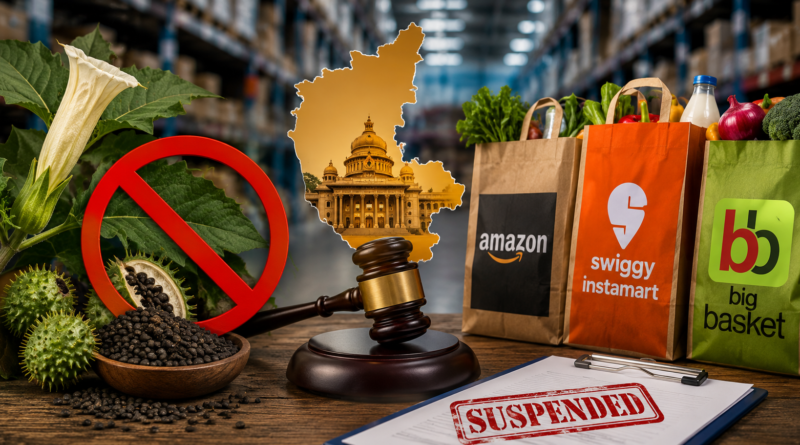
Karnataka Suspends Food Licences, of Amazon, Swiggy Instamart and BigBasket Over Datura Sales
Karnataka has taken strict action against three major e-commerce and quick-commerce platforms after poisonous Datura (Dhatura) fruits and seeds were found listed and sold online as food products. The Karnataka Food Safety and Drugs Administration Department has suspended the food licences of Amazon, Swiggy Instamart and BigBasket until further orders.
The action has raised serious questions about food-safety checks on online grocery platforms, particularly when products are supplied by third-party sellers.
Why Did Karnataka Suspend the Licences?
The matter came to light after food-safety officials found Datura fruits and seeds being offered for sale through online platforms, in some cases carrying FSSAI food registration or licence numbers. Officials also found packets of the products stored in warehouses and being distributed through e-commerce channels.
The Karnataka FDA said Datura is poisonous and that selling, storing or distributing it as a food product is not permissible because consumption can pose a serious risk to public health.
Following the investigation and complaints regarding the online listings, the department ordered the immediate suspension of the food licences and registrations associated with the platforms.
What Is Datura and Why Is It Dangerous?
Datura, commonly known as Dhatura or Devil’s Trumpet, is a poisonous plant. Its fruits and seeds contain toxic compounds, including atropine, which can cause severe poisoning when consumed.
Experts have warned that ingestion can lead to symptoms such as severe intoxication, loss of consciousness and psychosis. In serious cases, poisoning can also affect the heart and nervous system.
The concern becomes even greater when such products are presented or marketed as food because consumers may not realise that they are dealing with a toxic plant.
Amazon, Swiggy Instamart and BigBasket Ordered to Remove Listings
The Karnataka FDA has directed the three platforms to immediately remove listings, advertisements and promotional material offering Datura fruits or seeds for human consumption.
They have also been ordered to stop selling, distributing or displaying the products as food in the future.
The regulatory action does not stop with the platforms. Authorities have also ordered action against the suppliers and sellers who provided the Datura products to the online businesses. Their food licences and registrations have also been ordered to be suspended.
What Did the Companies Say?
The companies were given an opportunity to respond during proceedings before the food-safety authority.
According to the reported proceedings, Amazon did not submit a response at the time of the hearing, while Swiggy Instamart requested additional time to provide documents detailing the steps it had taken.
BigBasket said it had stopped the online sale of the Datura fruits and indicated that future labelling would clearly state “Not for human consumption.” However, the authority considered the responses and explanations unsatisfactory given the potential public-health risk.
Why This Case Matters for Online Shopping
The incident highlights a growing challenge for India’s rapidly expanding quick-commerce and e-commerce industry.
Consumers increasingly rely on apps for groceries, vegetables, household products and other everyday items. While the convenience is undeniable, the presence of third-party sellers can make it more difficult for platforms and regulators to ensure that every listed product complies with food-safety rules.
The Datura case therefore raises an important question: Who is responsible when a dangerous product appears online as food?
For regulators, the answer involves both the seller and the platform through which the product reaches consumers.
Licences Suspended Until Further Orders
The suspension is currently in force until further orders. The platforms can seek reconsideration after submitting compliance reports and responding to the regulatory proceedings. The department has indicated that the suspension can be reviewed after the concerned parties are given an opportunity to be heard.
The authorities have also instructed the relevant state and central licensing officials to take appropriate action against establishments and sellers involved in supplying the products.
A Warning for E-Commerce Platforms
The Karnataka action sends a strong message to online grocery and quick-commerce companies: food-safety compliance cannot stop at the platform’s own warehouses.
Third-party sellers, product descriptions, labelling, storage and the classification of products all need to be monitored carefully. A product that is harmless or useful in one context cannot simply be presented as food without meeting applicable safety requirements.
The case also highlights the importance of consumers being cautious when purchasing unfamiliar products online.
The Bigger Food-Safety Concern
Karnataka’s action against Amazon, Swiggy Instamart and BigBasket is not simply about one unusual product. It reflects a much wider concern over how food products are identified, verified and monitored in the rapidly growing online marketplace.
With Datura being toxic and unsuitable for human consumption, authorities have taken the position that its sale as food represents an unacceptable public-health risk.
For the platforms, the immediate priority will be demonstrating compliance and strengthening their checks. For regulators, the case could become another example of why food-safety enforcement needs to keep pace with the growth of quick commerce.
The key takeaway: A product appearing on a popular shopping app does not automatically mean it is safe or approved for consumption. The Karnataka Datura case is a sharp reminder that online food marketplaces need strong seller verification, accurate labelling and continuous safety monitoring.