
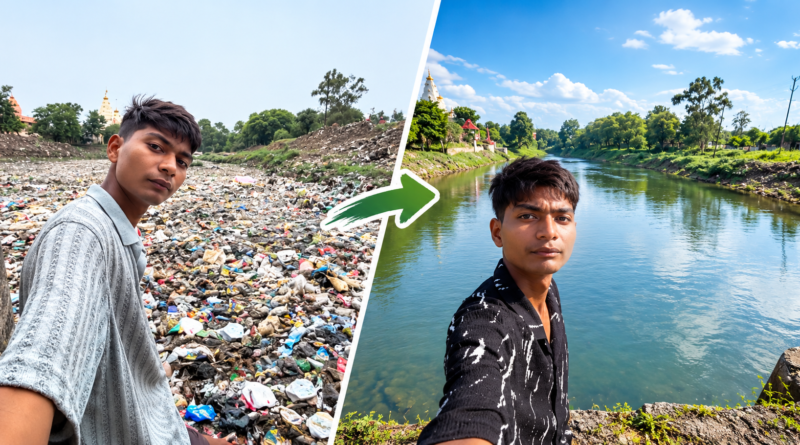
Bittu Tabahi: Young Indian Cleans Polluted River With His Own Hands, Gets Job Offer From Dutch Environmentalist
Surendra Singh Choudhary, popularly known as Bittu Tabahi, spent months cleaning the polluted Ajnar River in Madhya Pradesh. His grassroots effort has now taken him from a local clean-up mission to the global environmental spotlight after The Ocean Cleanup founder Boyan Slat invited him to work with the organisation.
A young environmental volunteer from Madhya Pradesh has turned an ordinary act of civic responsibility into an extraordinary opportunity.
Surendra Singh Choudhary, known online as Bittu Tabahi, spent months manually cleaning the heavily polluted Ajnar River in Rajgarh district. Working largely on his own, he removed plastic, bottles, algae, sludge, religious offerings and other waste that had accumulated in the water and along its banks.
His efforts eventually caught the attention of Boyan Slat, the Dutch founder and CEO of environmental organisation The Ocean Cleanup. After seeing a social media post showing Choudhary’s river-cleaning work, Slat responded with a short but remarkable invitation: “Come work for us.”
The comment instantly transformed Bittu Tabahi’s local environmental campaign into an international story.
Who Is Bittu Tabahi?
Bittu Tabahi is the online name of Surendra Singh Choudhary, a student and environmental volunteer from Biaora in Madhya Pradesh’s Rajgarh district.
Reports differ slightly on his age, describing him as either 20 or 21, but all agree that he is a young college student who began cleaning the Ajnar River after becoming concerned about its deteriorating condition.
The Ajnar River had become heavily contaminated with plastic waste, discarded bottles, algae, sludge, religious offerings and other debris. In some sections, the accumulation of garbage was so extensive that the water was barely visible.
Rather than waiting for a formal clean-up programme, Choudhary decided to begin removing the waste himself.
How Did His River-Cleaning Mission Begin?
According to NDTV, Choudhary began his clean-up campaign on January 26, 2026, Republic Day.
He initially worked with a few friends, but the effort gradually became largely a solo mission. Using basic tools, he entered polluted stretches of the river and manually removed garbage from the water and surrounding areas.
Moneycontrol reported that he and his friends pooled money to purchase cleaning equipment and dustbins, while Choudhary also spent his own savings on the project. The report estimated that he spent around ₹30,000 on the clean-up effort.
The work was physically demanding and carried obvious risks. Reports say he sometimes worked without proper protective equipment and did not know how to swim. He also faced skin irritation and infections from prolonged exposure to polluted water, while encounters with snakes added another danger.
Yet he continued returning to the river.
From Plastic Waste to Religious Offerings
The clean-up was not limited to plastic bottles and bags.
Choudhary also removed algae, sludge and discarded religious offerings from the river. According to Moneycontrol, he began collecting some of these offerings and converting them into compost, helping prevent the material from returning to the water.
His approach reflected a simple idea: instead of treating the polluted river as someone else’s problem, he would take responsibility for the part he could change.
Before-and-after images shared through social media showed a visible difference in sections of the Ajnar River after months of work. Those images helped his story spread far beyond Biaora.
Bittu Tabahi’s Efforts Go Viral
The transformation of the river eventually attracted widespread attention online.
Videos and photographs showing Choudhary working in the polluted water began circulating on social media. His persistence also attracted praise from prominent figures, including industrialist Anand Mahindra, who highlighted his determination and described him as a source of motivation.
But the viral attention also came with criticism.
Moneycontrol reported that some locals questioned why Choudhary was taking on the work himself, while others accused him of doing it for social media attention. He continued the clean-up despite those doubts and the physical difficulties involved.
Boyan Slat Notices Bittu’s Work
The biggest development came when a post about Choudhary’s work reached Boyan Slat, founder and CEO of The Ocean Cleanup.
The organisation is known for developing technologies and carrying out projects aimed at removing plastic pollution from oceans and rivers.
An X post highlighted Choudhary’s months-long effort to clean the Ajnar River and included before-and-after photographs. Slat responded directly to the post on September 4, 2026.
His message contained just four words:
“Come work for us.”
The simple invitation quickly went viral itself, with social media users celebrating the possibility of Choudhary joining an organisation dedicated to tackling plastic pollution around the world.
From a Local River to a Global Mission
The potential opportunity is significant because Bittu’s work and The Ocean Cleanup’s mission operate on very different scales.
Choudhary began with a single river near his hometown, basic equipment and his own time. The Ocean Cleanup, meanwhile, works on plastic pollution across rivers and oceans through large-scale environmental projects and technology.
That contrast has made his story particularly powerful.
His experience of physically removing waste from a polluted waterway could also give him a perspective that cannot easily be learned in a classroom: seeing first-hand how plastic and other debris accumulate in waterways and how difficult it can be to remove them manually.
At the same time, the job invitation should currently be described as an offer or invitation, rather than a confirmed appointment. The reports do not indicate that Choudhary has formally accepted the position or joined The Ocean Cleanup yet.
Madhya Pradesh Chief Minister Also Takes Notice
The recognition has not been limited to international environmental circles.
Madhya Pradesh Chief Minister Mohan Yadav invited Choudhary to the Chief Minister’s residence after his efforts gained attention. The CM praised his initiative and assured him of government support, according to NDTV.
That adds another dimension to the story: what began as an individual’s attempt to clean a neglected waterway has now drawn attention from both government and international environmental organisations.
Why Bittu Tabahi’s Story Matters
The Ajnar River story is more than a viral success story.
It highlights the enormous amount of waste that can accumulate in local water bodies when plastic, household rubbish and other material are improperly discarded.
It also shows how individual action can attract attention even when it begins without institutional backing.
Bittu did not start with a large organisation, expensive machinery or a major environmental campaign. He started with a polluted river and a decision to do something about it.
His story also demonstrates the growing role of social media in connecting local environmental efforts with international audiences. Without the videos, photographs and before-and-after images shared online, his work may never have reached Boyan Slat.
What Happens Next for Bittu Tabahi?
For now, the biggest question is whether Bittu Tabahi will accept Boyan Slat’s invitation and eventually work with The Ocean Cleanup.
Regardless of what happens next, his work has already given him a national and international platform.
From Biaora’s Ajnar River to the attention of one of the world’s best-known environmental organisations, Choudhary’s journey is an example of how persistent action can travel far beyond its starting point.
His story began with a simple choice: instead of waiting for someone else to clean the river, he decided to start himself.
Now, that same decision could potentially take him from cleaning one polluted river in Madhya Pradesh to becoming part of a global fight against plastic pollution.