
Haryana Man Gets ₹2,000 Speeding Challan, but Location Points to ‘Null Island’
Haryana Man Speeding Challan: 5 Bizarre Details Explained
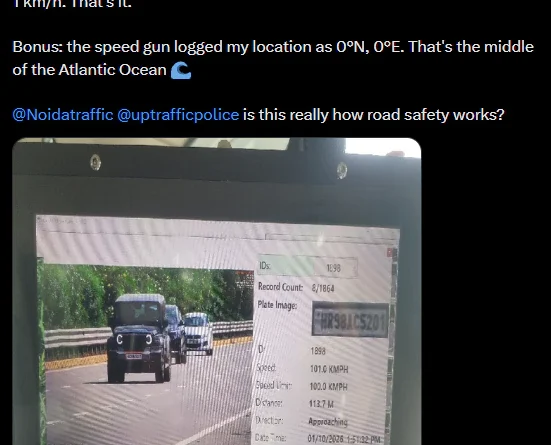
The vehicle was reportedly recorded travelling at 101 kmph on the Yamuna Expressway, just 1 kmph above the permitted limit. However, the challan listed coordinates of 0°N and 0°E, raising questions about the accuracy of the location data.
Haryana man speeding challan has sparked an online debate after a driver received a ₹2,000 penalty for allegedly travelling at 101 kmph on the Yamuna Expressway, just 1 kmph above the permitted speed limit. However, the controversy was not limited to the fine. The location recorded in the challan reportedly showed coordinates in the middle of the Atlantic Ocean, leaving the driver questioning the accuracy of the traffic enforcement record.
The incident came to light after X user Anujeet Shivam shared an image of the challan and described the unusual details on his account. According to the document, his black SUV was recorded travelling at 101 kmph, while the permitted speed limit was listed as 100 kmph.
The challan also showed the alleged violation date as January 10, 2026, at approximately 3:13 pm.
Why the Speeding Challan Raised Questions
In his post, Shivam questioned the ₹2,000 penalty for exceeding the speed limit by just 1 kmph. However, what particularly caught his attention was the location information included in the speed gun record.
The latitude and longitude were reportedly listed as 0°N and 0°E. These coordinates are commonly associated with a location in the Atlantic Ocean known as Null Island.
Null Island is an informal name used for the point where the Equator meets the Prime Meridian. It is often used in mapping and data systems to represent missing or incorrectly recorded geographic coordinates.
The unusual location entry raised questions about whether the speed detection equipment had accurately recorded the location of the alleged traffic violation.
Shivam tagged Noida Traffic Police and Uttar Pradesh Traffic Police in his post, questioning the reliability of the record and asking whether this was how road safety enforcement was supposed to work.
Noida Traffic Police Responds to the Post
The post attracted attention online, prompting a response from Noida Traffic Police. The department asked Shivam to contact the e-challan helpline number for assistance.
However, the response shared in the supplied report did not provide a detailed explanation for why the challan displayed the coordinates 0°N and 0°E.
The central issue raised by the driver therefore remained the accuracy of the location information and the circumstances surrounding the recorded speed.
Social Media Divided Over the ₹2,000 Fine
The incident triggered mixed reactions among social media users. While some questioned the accuracy of the challan, others argued that the driver was still responsible for following the posted speed limit.
Several users pointed out that a 100 kmph speed limit represents the maximum permitted speed, not a target that motorists are expected to match. From this perspective, even travelling slightly above the limit could constitute a violation.
Others questioned why the driver was challenging the penalty when the recorded speed was higher than the permitted limit.
One user also claimed that speed radar systems generally have a 5 kmph error allowance built into them, suggesting that the vehicle could have been travelling faster than the recorded speed when detected. However, this was a claim made by a social media user and was not independently established in the supplied report.
What Is Null Island and Why Does It Matter?
The reference to Null Island became one of the most unusual aspects of the incident. The coordinates 0°N and 0°E identify the intersection of the Equator and the Prime Meridian in the Atlantic Ocean.
In digital mapping systems, these coordinates are sometimes associated with records where geographic location data is missing, incorrectly entered or not properly processed.
Their appearance on a traffic challan does not, by itself, establish that the speed reading was inaccurate. However, it raises a legitimate question about the reliability of the location details recorded in the document.
The incident highlights the importance of accurate data in automated traffic enforcement systems. While speed limits are intended to improve road safety, enforcement records also need to provide reliable information that motorists can examine and challenge when necessary.
For now, the unusual challan has generated debate over both the ₹2,000 penalty and the location recorded in the speed gun data. Whether the traffic authorities will provide further clarification remains to be seen.