
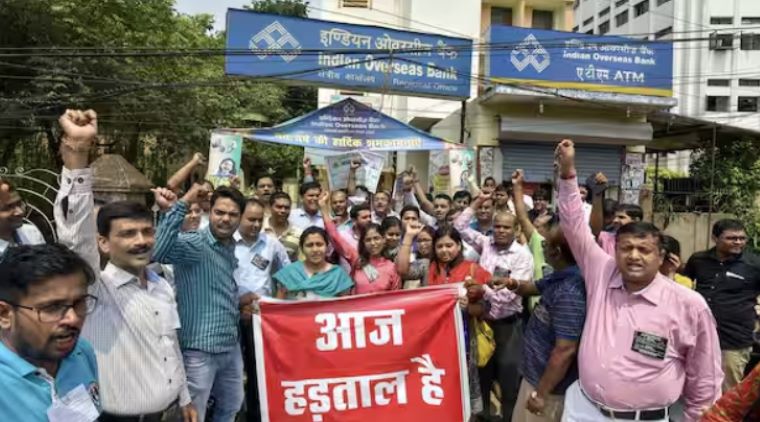
Bank Strike in India: Services Hit as Employees Demand 5-Day Work Week
A nationwide bank strike by bank employees is underway on January 27, 2026, disrupting banking services across the country as workers protest for better working conditions and a five-day work week.
Employees from both public and private sector banks joined the strike, leading to closures, reduced services and customer inconvenience.
What the Strike Is About
The main demand of the striking employees is the implementation of a five-day work week for bank staff across India. Currently, most banks operate on a six-day week, with employees working Saturdays to meet service and customer requirements.
Union leaders argue that a five-day week is necessary to improve work-life balance, reduce stress and align with practices in other sectors where a shorter work week is becoming the norm.
In addition to the five-day week demand, employees are also calling for improvements in service conditions, staffing levels and welfare measures.
Impact on Banking Services
The strike has led to significant disruptions in routine banking operations:
Banks Closed or Running Limited Services
- Many public sector banks including major ones like State Bank of India (SBI), Punjab National Bank (PNB), Bank of Baroda (BOB) and others have either fully closed branches or are operating with minimal staff.
- Affected services include cash withdrawals and deposits, cheque clearances, loan application processing, account openings and other in-branch activities.
- Some banks have announced that only critical services will be available during the strike period.
Customers Affected
Customers have faced inconvenience trying to complete basic tasks such as withdrawing cash, depositing cheques or accessing certain in-branch services. Many people have had to return home without completing transactions, especially in smaller towns and rural areas where alternative options are limited.
ATM withdrawals still remain possible in most places, provided machines have sufficient cash. Online banking and mobile app services continue for account access and fund transfers, although certain services that require branch intervention may not be completed until after the strike.
Public Sector Banks Most Impacted
The strike has been particularly felt in public sector banks, where employee participation has been higher. Many branches of these banks are either shut entirely or functioning with skeletal teams to manage only urgent transactions.
Private banks in some regions have also reported reduced operations, depending on staff participation in the protest.
Union Response and Government Position
Bank unions have expressed strong views, saying the strike reflects deep dissatisfaction among employees who have long faced heavy workloads and extended working hours. They believe a five-day work week will benefit employee health and morale without adversely affecting customers in the long run.
Officials from the finance ministry and bank management committees have acknowledged the concerns but also emphasised the need to balance customer service continuity with employee welfare. Talks between unions and bank management on this issue are expected to continue after the strike.
Advice for Customers
In light of the ongoing strike, customers are being advised to:
- Use online and mobile banking services for routine transactions such as fund transfers, bill payments and balance checks.
- Visit bank branches only for essential work that cannot be done digitally.
- Withdraw sufficient cash from ATMs ahead of time if needed, as some branches may remain closed.
- Contact bank helplines for assistance on specific queries or emergency needs.
What Happens Next?
The strike is currently planned for one day, but its scale and impact will likely influence follow-up discussions between unions and authorities. If negotiations do not yield quick results, further actions or extended strikes could be considered by employee organisations.
For now, banks are expected to return to normal operations once the strike ends, restoring full in-branch services.