
Cyclone Narelle Turns Australian Sky Red: Causes, Science, and Impact
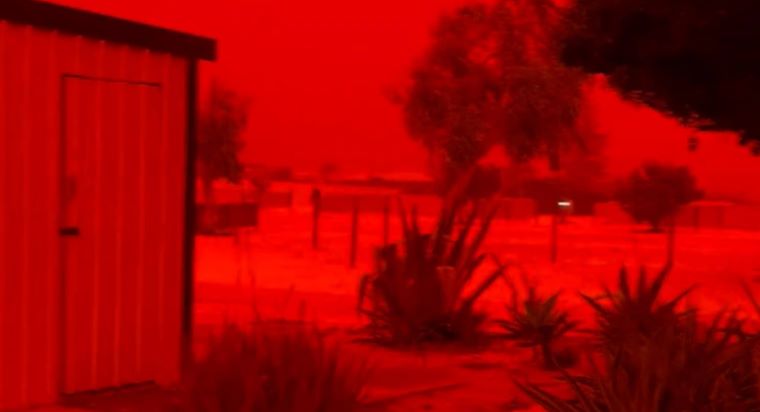
A rare and dramatic natural phenomenon recently captured global attention when the skies over Western Australia turned a deep blood-red ahead of Cyclone Narelle. The eerie visuals, widely shared on social media, appeared almost apocalyptic—but the science behind them is both fascinating and explainable.
What Happened?
In late March 2026, residents in regions like Shark Bay and Denham witnessed the sky transform into a crimson-red haze during daytime. The unusual color made landscapes appear surreal, with visibility dropping significantly.
This phenomenon occurred as Cyclone Narelle approached Western Australia, bringing strong winds and atmospheric disturbances.
Locals described the experience as:
“Red everywhere… gritty dust in the air and eyes.”
The event lasted several hours before clearing as rainfall and stronger winds arrived.
Why Did the Sky Turn Red?
The red sky was not a supernatural event—it was the result of a combination of meteorological and optical factors.
1. Iron-Rich Dust Storms
Western Australia has iron-rich red soil, especially in inland regions. As the cyclone approached:
- Powerful winds lifted massive amounts of red dust into the atmosphere
- This dust spread across coastal regions like Shark Bay
- The thick dust layer acted like a filter for sunlight
2. Light Scattering (Atmospheric Physics)
The red color can be explained by a scientific concept known as Rayleigh scattering:
- Sunlight contains multiple colors (wavelengths)
- Shorter wavelengths (blue) scatter more easily
- Longer wavelengths (red/orange) dominate when dust blocks blue light
With heavy dust in the air, only red wavelengths were visible, creating the intense crimson glow.
3. Cyclone-Induced Conditions
The cyclone amplified the effect by:
- Creating strong winds that transported dust over long distances
- Increasing moisture and cloud cover, which enhanced color intensity
- Forming dense atmospheric layers that trapped particles
This rare combination produced the dramatic sky transformation.
Why Did It Look So “Apocalyptic”?
The sky appeared unusually dark and red because:
- Dust concentration was extremely high
- Sunlight was heavily filtered
- Visibility dropped significantly
- The event occurred during daylight, making the contrast more striking
Such visuals are uncommon but not unprecedented in arid regions during strong storms.
Impact of Cyclone Narelle
Beyond the visual spectacle, Cyclone Narelle had significant real-world impacts:
- Strong winds and heavy rainfall across Western Australia
- Dust storms reducing air quality and visibility
- Disruptions to infrastructure and daily life
- Temporary power and service outages in some areas
The cyclone itself followed an unusual path, making landfall across multiple regions—something rarely seen in decades.
Is This Dangerous?
While the red sky looks alarming, it is generally not dangerous by itself, but it signals:
- Incoming severe weather conditions
- Poor air quality due to dust particles
- Possible storms, rainfall, or strong winds
People are usually advised to stay indoors during such events to avoid inhaling dust.
Scientific and Environmental Significance
This event highlights how natural elements interact:
- Geography (iron-rich soil)
- Weather systems (cyclones)
- Physics (light scattering)
It also shows how extreme weather events can create rare visual phenomena, especially in regions with dry landscapes.
Conclusion
The red skies seen before Cyclone Narelle were a striking reminder of nature’s power and complexity. What looked like a scene from a science-fiction movie was actually the result of dust, sunlight, and atmospheric science working together.
Such events, while rare, help scientists better understand weather patterns and also remind us of the dynamic relationship between climate and environment.