
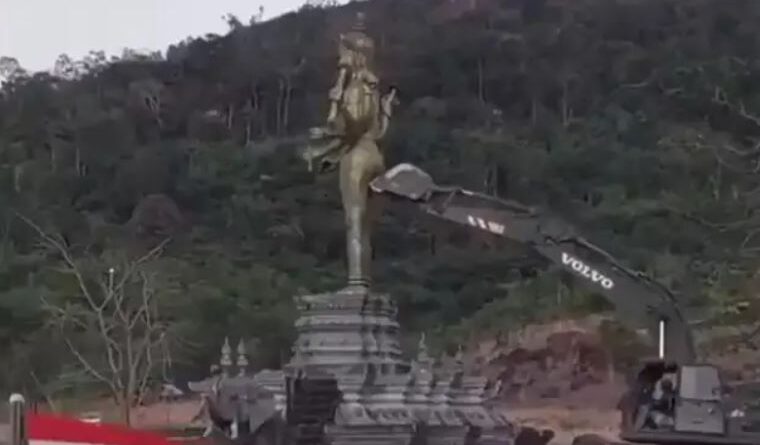
Destruction of Lord Vishnu Statue Amid Thailand–Cambodia Border Tensions
The recent demolition of a Lord Vishnu statue in a disputed border region between Thailand and Cambodia has sparked diplomatic tensions, public outrage, and international concern. The incident goes beyond a simple border disagreement, touching upon religious sentiment, cultural heritage, media ethics, and international diplomacy. It highlights how symbolic acts in conflict zones can escalate tensions and influence regional stability.
What Happened Destruction of Lord Vishnu Statue
A statue of Lord Vishnu, a deity revered in Hinduism and respected within Southeast Asia’s shared Hindu-Buddhist heritage, was reportedly destroyed using heavy machinery in a contested area near the Thailand–Cambodia border. The statue had reportedly been standing for several years and was regarded as a religious and cultural symbol by local communities.
Video footage showing the statue being toppled circulated widely on social media, intensifying public reaction across multiple countries, particularly India and Southeast Asian nations with historical Hindu-Buddhist traditions.
Territorial Dispute Context
The incident occurred in a long-disputed border region, where Thailand and Cambodia have historically disagreed over territorial demarcation. The area has seen intermittent military tensions, ceasefire violations, and civilian displacement in the past.
Cambodia maintains that the statue stood well within its sovereign territory, while Thailand considers the zone either disputed or under its operational control due to security considerations. The lack of mutually accepted border demarcation has made cultural and religious structures in the region especially vulnerable.
Cambodia’s Position
Cambodian authorities strongly condemned the demolition, describing it as:
- A violation of Cambodian sovereignty
- An attack on religious and cultural heritage
- An act that disrespects faith traditions followed by millions across Asia
Officials emphasized that the statue was not merely a religious idol but a representation of the region’s shared civilizational history, where Hindu and Buddhist traditions have coexisted for centuries.
Thailand’s Explanation
Thai authorities responded by stating that:
- The removal of the statue was not religiously motivated
- The structure was located in a security-sensitive zone
- The action was part of operational or administrative measures following military movements
Thailand asserted its respect for all religions and clarified that the action should not be interpreted as hostility toward Hindu beliefs. However, this explanation failed to fully ease regional and international concerns.
India’s Reaction
India officially expressed strong disapproval, describing the demolition as a deeply disrespectful act that hurt the sentiments of devotees worldwide. Indian officials emphasized:
- The importance of protecting shared cultural and spiritual heritage
- The need for restraint in conflict zones
- The value of resolving disputes through dialogue and diplomacy
India also urged both nations to avoid actions that could inflame religious emotions or destabilize the region.
Public and Media Response
Public Outrage
The incident triggered widespread anger on social media platforms, with users calling for:
- Accountability
- Protection of religious monuments
- Respect for faith symbols even during territorial disputes
Media Ethics Dimension
The extensive circulation of demolition footage raised important questions regarding:
- Responsible reporting of religiously sensitive content
- Avoiding sensationalism during international disputes
- The role of media in either calming or escalating tensions
Cultural and Religious Significance
Lord Vishnu holds a special place not only in Hinduism but also in Southeast Asian history. Ancient temples, inscriptions, and art across Cambodia and Thailand reflect strong Hindu influences dating back centuries.
The destruction of such a statue is therefore viewed not only as a religious affront but also as a loss of cultural heritage, weakening shared historical bonds between neighboring nations.
Broader Implications
This incident underscores several critical issues:
- How religious symbols become collateral damage in geopolitical conflicts
- The importance of cultural sensitivity in military operations
- The role of international diplomacy in preventing symbolic acts from escalating into larger crises
It also highlights the need for international norms that protect cultural and religious heritage in disputed or conflict-prone areas.
Conclusion
The demolition of the Lord Vishnu statue at the Thailand–Cambodia border represents more than a local dispute. It stands at the intersection of religion, sovereignty, media responsibility, and international relations. While territorial disagreements may persist, respect for cultural and religious symbols remains essential to maintaining peace and mutual understanding.
The incident serves as a reminder that in an interconnected world, actions taken in disputed regions resonate far beyond borders — affecting faith communities, diplomatic relations, and regional harmony.