
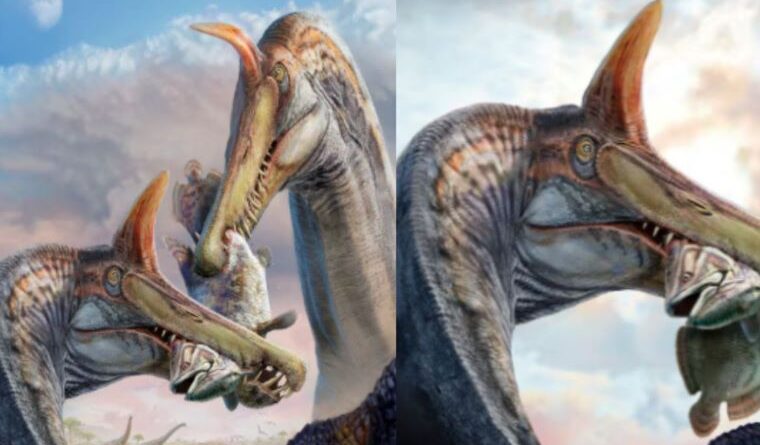
New “Spinosaur” Species Unearthed in the Sahara — A Giant Unlike Any Seen Before
Paleontologists have announced the discovery of a previously unknown species of dinosaur in the remote Sahara Desert that adds a remarkable new chapter to our understanding of giant predatory dinosaurs. This newly identified species belongs to the group broadly related to Spinosaurus, the distinctive crocodile-like meat-eater that once roamed parts of Africa, but it shows a combination of features unseen in other known species.
The fossil remains were unearthed in Niger, in sedimentary rock dating back roughly 95 million years to the mid-Cretaceous period. Scientists say this discovery not only expands the diversity of spinosaurids but also challenges previously held ideas about how these extraordinary predators lived and evolved.
What Makes This Discovery Special?
Spinosaurids are known for their elongated skulls, conical teeth and aquatic adaptations, which suggest they may have been semi-aquatic hunters feeding on fish and other prey near river systems. However, the newly described species — informally dubbed by researchers as the “new spinosaur” — has a unique blend of anatomical traits that set it apart from its cousins, including:
- Larger, more robust limb bones not typical of previously known spinosaurids
- Distinctive vertebrae shapes that suggest it may have moved differently on land
- Unusual skull and jaw features that hint at a varied diet
These differences suggest that this species may have exploited a wider range of environments and food sources than other spinosaurs, which were typically thought to specialise in fish-hunting.
The Sahara’s Hidden Treasures
The Sahara Desert is one of the most expansive and extreme environments on Earth today, but during the Cretaceous period it was a very different landscape — lush with rivers and floodplains that supported abundant life, including large dinosaurs. Fossils from this region have been difficult to access due to the remote terrain, but recent expeditions by international research teams have made significant breakthroughs.
The fossil fragments that led to this discovery were first spotted during a 2019 field season led by a team of paleontologists working in collaboration with local researchers. The bones were later prepared and studied over several years, with advanced imaging techniques revealing key details about their structure.
A New Chapter in Dinosaur Evolution
Experts say the discovery challenges some long-held assumptions about how spinosaurids lived and diversified. Until now, the best-known spinosaur — Spinosaurus aegyptiacus — was famous for its sail-like back structure and evidence suggesting a semi-aquatic lifestyle. This new species, while related, appears to have had adaptations better suited for land — suggesting that spinosaurids may have occupied a broader ecological spectrum than previously recognised.
“This find shows that these animals were not just specialised fish eaters,” one lead researcher noted. “They were evolving a variety of forms and lifestyles, which tells us that the Cretaceous ecosystems were far more complex than our textbooks have described.”
Scientific Importance and Future Work
The discovery has already sparked excitement in the scientific community. Researchers believe this new species will help clarify:
- The evolutionary relationships among large predatory dinosaurs in Gondwana (the supercontinent that included Africa and South America)
- How large predators co-existed and shared resources in diverse Cretaceous ecosystems
- The pace and pattern of spinosaurid evolution over millions of years
Further fieldwork is planned in the region to search for additional fossil evidence that may reveal more about this animal’s size, lifestyle and place in the prehistoric food web.
Public and Educational Impact
This extraordinary discovery has the potential to capture public imagination in the same way as earlier finds like T. rex and Triceratops. Museums and educational institutions are already expressing interest in the new species, which offers fresh insights into dinosaur diversity and behaviour.
For young paleontology enthusiasts and students, the new spinosaur discovery is a vivid reminder that even after decades of study, Earth’s ancient past still holds many secrets waiting to be uncovered.
Conclusion
The unearthing of a new spinosaurid dinosaur species in the Sahara represents a major addition to the fossil record and deepens our understanding of dinosaur diversity and evolution. With its unusual mix of physical traits, this giant predator broadens the narrative of how ancient ecosystems functioned and how prehistoric life adapted to changing environments millions of years ago.