
OpenAI Introduces ChatGPT Prism: A Free AI Workspace for Scientific Writing and Collaboration
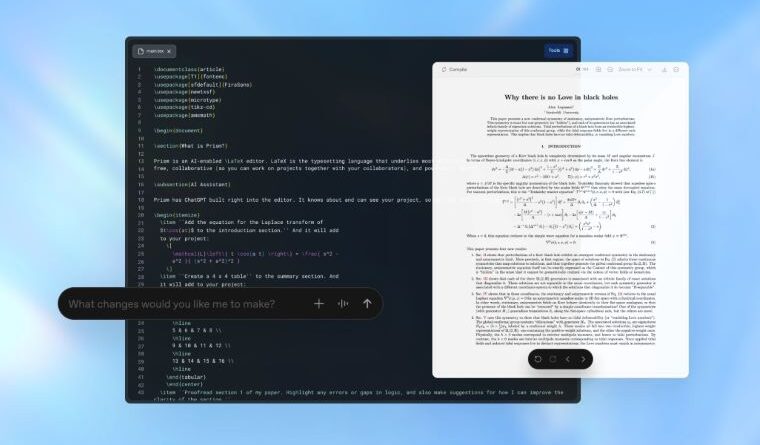
OpenAI has introduced ChatGPT Prism, a free AI-powered workspace designed to help scientists, researchers, and academics write, edit, and collaborate on scientific documents. Prism is powered by GPT-5.2, OpenAI’s latest advanced model built for complex reasoning and long-context understanding. This launch reflects OpenAI’s push to embed AI directly into professional research workflows, especially in scientific writing where multiple tools are traditionally required.
What ChatGPT Prism Is
ChatGPT Prism is an AI-integrated writing and research environment that combines document creation, AI assistance, and collaboration in one place. Instead of using a separate AI chat tool alongside writing software, Prism allows AI to work inside the document itself, understanding its structure, equations, references, and overall context.
Built on a cloud-based LaTeX framework, Prism removes the need for local installations. Researchers can access their work from anywhere and collaborate seamlessly across devices and locations.
Key Features of ChatGPT Prism
1. Integrated Writing and AI Assistance
Prism allows users to draft, edit, and refine full scientific papers with AI assistance that understands the entire document. This results in better flow, logical consistency, and improved clarity across all sections of a paper.
2. Deep Context Awareness
Powered by GPT-5.2, Prism can understand long and complex documents. It takes into account sections, formulas, figures, and references while suggesting edits or generating content, making AI support far more relevant than standard chat-based tools.
3. Equation, Citation, and Diagram Support
Prism supports equations, citations, and diagrams commonly used in scientific writing. It can convert handwritten notes or rough sketches into structured LaTeX equations, reducing manual formatting work and minimizing errors.
4. Literature Search and Reference Integration
Researchers can search for academic literature directly within the workspace and insert references into their documents without switching between multiple platforms, saving time and improving workflow efficiency.
5. Real-Time Collaboration
The platform supports unlimited collaborators working on the same document simultaneously. Co-authors, supervisors, and research teams can edit, comment, and revise content in real time, eliminating version-control issues.
6. Voice-Based and AI-Assisted Editing
Prism also offers voice-based commands for editing and navigation. AI helps with proofreading, formatting corrections, and consistency checks, making the writing process faster and smoother.
Free Access and Availability
ChatGPT Prism is available free of cost to users with a personal ChatGPT account. There are no limits on the number of projects or collaborators, making it especially valuable for students, early-career researchers, and institutions with limited budgets. OpenAI plans to expand Prism access to business, enterprise, and education users in future updates.
Why ChatGPT Prism Matters
Scientific research often requires juggling multiple tools such as document editors, reference managers, LaTeX compilers, and separate AI assistants. Prism aims to eliminate this fragmentation by providing a single AI-native workspace.
By integrating GPT-5.2 directly into the research process, Prism significantly reduces time spent on formatting and revisions, allowing researchers to focus more on innovation, analysis, and discovery.
GPT-5.2: The Technology Behind Prism
GPT-5.2 offers improved reasoning, stronger handling of long documents, better mathematical understanding, enhanced code interpretation, and advanced problem-solving abilities. These capabilities make it especially suitable for scientific, academic, and professional research tasks.
Looking Ahead
With ChatGPT Prism, OpenAI is moving beyond conversational AI toward embedded AI collaboration tools. Its free availability and powerful features have the potential to reshape how research papers are written, reviewed, and published, making advanced AI assistance a standard part of scientific work in the future.