
Super El Niño 2026: How It Could Impact India’s Monsoon, Farmers, and Global Climate
The possibility of a Super El Niño in 2026 is raising serious concerns among climate experts worldwide. According to recent forecasts, this rare and powerful climate phenomenon could significantly disrupt weather patterns—from weakening India’s monsoon to increasing global temperatures.
What Is Super El Niño?
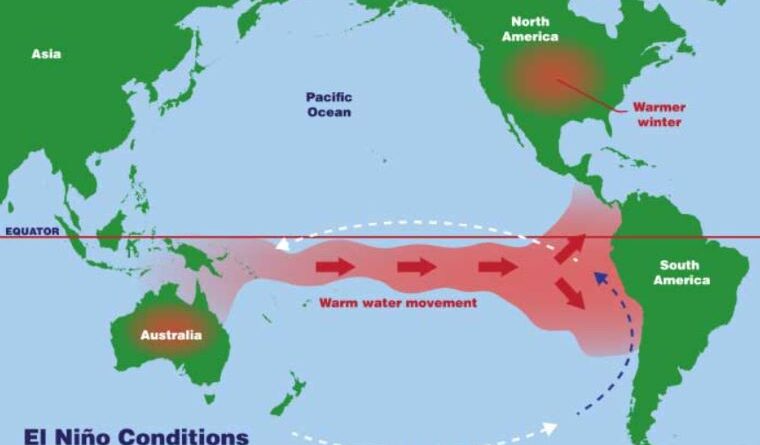
El Niño is a natural climate cycle caused by warming ocean temperatures in the Pacific Ocean. A Super El Niño occurs when this warming becomes exceptionally strong, leading to widespread and intensified weather disruptions across the globe.
Experts suggest that 2026 could witness one of the strongest El Niño events in decades, possibly rivaling historic events like 1997–98 and 2015–16.
Threat to India’s Monsoon
India’s monsoon is highly sensitive to El Niño conditions. Early forecasts indicate that the 2026 monsoon could be below normal, especially in the second half of the season.
Weather agencies predict rainfall could drop to around 94% of the long-period average, which is considered below normal.
El Niño weakens the monsoon by disrupting wind patterns that bring moisture to the Indian subcontinent. As a result, many regions may experience less rainfall, delayed monsoon onset, or uneven distribution of rain.
Impact on Farmers and Agriculture
The biggest concern is for India’s agriculture sector, which depends heavily on monsoon rains. Around 40 crore farmers could face serious challenges if rainfall remains weak.
A poor monsoon can lead to:
- Reduced crop yields
- Water shortages
- Increased irrigation costs
- Higher food prices
Experts warn that drought-like conditions may emerge in several parts of central and northern India if the Super El Niño strengthens.
Government officials and agricultural experts are already advising farmers to conserve water and prepare for uncertain rainfall patterns.
Rising Heat and Extreme Weather
Apart from weak rainfall, a Super El Niño could trigger extreme heatwaves across India. Temperatures may rise significantly above normal, especially during summer months.
Globally, the phenomenon could:
- Increase average temperatures
- Trigger droughts in some regions
- Cause heavy rainfall and floods in others
- Reduce Atlantic hurricanes but increase Pacific storms
Climate experts also warn that global temperatures could reach record highs by 2027 due to the heat released by the Pacific Ocean.
Global Impact of Super El Niño
The effects of a Super El Niño are not limited to India. It can disrupt weather systems worldwide:
- Asia & Australia: Drought conditions
- South America: Heavy rainfall and flooding
- Africa: Mixed impacts, including heatwaves
- United States: Shifted storm patterns
Such global disruptions can also impact food supply chains, economies, and energy demand.
Why 2026 Is Critical
Scientists believe that the coming months—especially June to August—will be crucial in determining the strength of El Niño. Current estimates show a high probability (over 60%) of its development, with chances increasing further later in the year.
While uncertainties remain, the growing signals of a strong event have prompted early warnings and preparedness measures.
Conclusion
The potential arrival of a Super El Niño in 2026 is a major concern for India and the world. From weaker monsoons and agricultural stress to rising global temperatures, its impact could be far-reaching.
For India, the stakes are particularly high, as millions depend on monsoon rains for their livelihood. Experts emphasize the need for early planning, water conservation, and climate-resilient strategies to minimize risks.
As climate patterns become more unpredictable, events like Super El Niño serve as a reminder of the urgent need to adapt to a changing environment.