
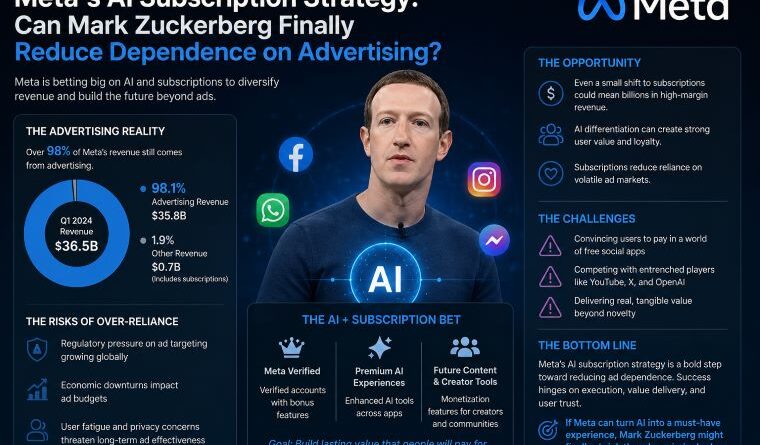
Meta’s AI Subscription Strategy: Can Mark Zuckerberg Finally Reduce Dependence on Advertising?
For nearly two decades, Meta Platforms has dominated the digital advertising industry through its flagship platforms, including Facebook, Instagram, and WhatsApp. Advertising has been the company’s primary revenue engine, generating hundreds of billions of dollars over the years. However, as artificial intelligence reshapes the technology landscape, Meta is making one of its biggest strategic shifts yet: charging users for premium services and AI-powered experiences.
The company recently announced new subscription plans across Facebook, Instagram, and WhatsApp while also preparing premium AI offerings under a broader initiative called “Meta One.” The move signals a significant attempt to diversify revenue streams beyond advertising and establish a sustainable business model for the AI era.
Why Meta Needs New Revenue Sources
Meta’s advertising business remains highly profitable, but the company is spending unprecedented amounts on AI infrastructure, data centers, chips, and model development. Industry analysts estimate that major technology companies could collectively invest hundreds of billions of dollars in AI-related infrastructure over the coming years. Meta is among the biggest spenders in this race.
While AI has already improved Meta’s advertising performance by helping deliver more targeted and efficient ads, investors increasingly want evidence that AI can become a direct revenue generator rather than simply a tool for improving ad sales.
This challenge is particularly important because Meta has historically struggled to monetize products outside its advertising ecosystem. Previous efforts in hardware, digital payments, and other subscription-based services achieved mixed results. The company now hopes AI can change that narrative.
Meta One: The Beginning of a Subscription Ecosystem
According to recent reports, Meta is rolling out paid subscription tiers for Instagram, Facebook, and WhatsApp globally. These plans include premium customization features, enhanced creator tools, advanced engagement options, and additional user controls. Pricing is expected to start at just a few dollars per month, making the services accessible to a broad audience.
More importantly, Meta plans to introduce higher-tier subscription packages under the “Meta One” brand. These premium offerings are expected to include:
- Advanced AI-powered content generation
- Enhanced image and video creation tools
- Creator-focused monetization features
- Business productivity tools
- More powerful AI assistant capabilities
- Premium discovery and profile enhancement options
The strategy resembles subscription ecosystems developed by companies such as Apple through Apple One and Google through Google One. Meta aims to create a similar bundle of digital services that encourages long-term recurring revenue.
The AI Monetization Opportunity
The global AI market is expanding rapidly, with consumers becoming increasingly willing to pay for advanced AI assistants, productivity tools, and content creation platforms. Companies such as OpenAI have demonstrated that users will subscribe to premium AI services when the value proposition is clear.
Meta hopes to leverage its massive user base of billions of people across Facebook, Instagram, WhatsApp, and its AI ecosystem. Even a small percentage of users converting to paid subscriptions could generate substantial revenue.
Some analysts estimate that Meta AI subscriptions could contribute billions of dollars annually within the next few years, potentially creating a significant new business segment alongside advertising.
Challenges Facing Meta’s Subscription Push
Despite the opportunity, Meta faces several obstacles.
First, consumers have long associated Meta’s social platforms with free access. Convincing users to pay for features that were previously available without charge could trigger resistance. Critics have already described the move as the end of the traditional “free social media” era.
Second, competition in AI subscriptions is intensifying. OpenAI, Google, Microsoft, and other technology leaders are rapidly expanding premium AI offerings. Meta must provide unique capabilities that justify recurring payments.
Third, WhatsApp’s historical promise of being a free communication platform creates additional sensitivity around monetization. Any perception that essential features are moving behind a paywall could create backlash among users.
What This Means for the Future of Meta
Meta’s subscription strategy represents more than just a new pricing model. It reflects a broader transformation in how technology companies plan to monetize artificial intelligence. Rather than relying solely on advertising, the company is positioning itself to generate recurring revenue from AI-powered products and premium digital experiences.
If successful, Meta could reduce its dependence on advertising while creating a more diversified and resilient business model. If users embrace premium AI services, the company may finally achieve something it has struggled to do for years: build a major revenue stream outside of ads.
The coming months will reveal whether consumers are willing to pay for Meta’s AI vision. One thing is clear: the social media giant is entering a new era where subscriptions and artificial intelligence could become as important as advertising itself.