
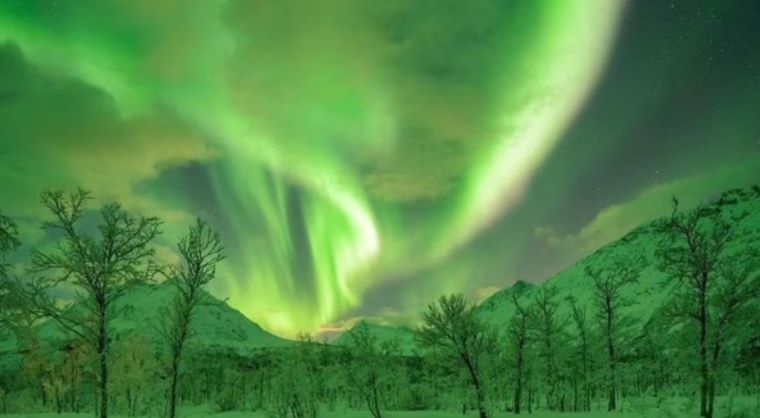
Solar Storm June 2026: Will India Witness the Northern Lights Tonight? Cities Most Likely to See Rare Auroras
Massive Solar Storm Could Light Up Indian Skies With Rare Aurora Display
A powerful solar storm is expected to impact Earth on June 8, 2026, raising excitement among astronomers and skywatchers worldwide. According to space weather agencies, a strong geomagnetic storm triggered by a Coronal Mass Ejection (CME) from the Sun could create conditions favorable for aurora sightings far beyond their usual polar locations. In an extraordinary development, parts of northern India may get a rare opportunity to witness the Northern Lights, also known as the Aurora Borealis.
The event has generated significant interest because auroras are typically visible only in regions close to the Arctic and Antarctic circles. However, when powerful solar storms interact with Earth’s magnetic field, the colorful light displays can sometimes be seen at much lower latitudes. Experts say the June 8 geomagnetic storm could be one of those rare occasions.
What Is Causing the Solar Storm?
The ongoing solar storm originated from a massive eruption on the Sun known as a Coronal Mass Ejection (CME). During such events, billions of tons of charged solar particles are blasted into space. When these particles reach Earth, they interact with the planet’s magnetosphere, causing geomagnetic disturbances.
Scientists have classified the incoming event as a G3 (Strong) geomagnetic storm. While not the most severe category, it is powerful enough to enhance auroral activity significantly and potentially affect satellite communications, GPS signals, and radio transmissions.
The Sun is currently experiencing heightened activity as part of its solar cycle, leading to more frequent solar flares and CMEs. This increased activity is one reason why major aurora displays have become more common over the past two years.
Can the Northern Lights Really Be Seen in India?
Yes, under ideal conditions, some parts of India could witness the aurora tonight. Experts suggest that northern Himalayan regions offer the best chances due to their high altitude, low light pollution, and proximity to higher geomagnetic latitudes.
Potential locations include:
- Ladakh
- Hanle
- Leh
- Spiti Valley
- Parts of Himachal Pradesh
- High-altitude regions of Uttarakhand
- Certain areas of Jammu and Kashmir
Residents in these locations may observe faint green, pink, or purple glows near the northern horizon if weather conditions remain clear.
However, experts caution that aurora visibility depends on several factors, including cloud cover, atmospheric conditions, geomagnetic intensity, and local light pollution.
Best Time to Watch the Aurora in India
Skywatchers hoping to catch the phenomenon should look toward the northern horizon after sunset and continue observing through the late-night hours.
For the best viewing experience:
- Move away from city lights.
- Choose elevated locations with clear northern views.
- Allow your eyes to adapt to darkness for at least 20 minutes.
- Use a smartphone camera with night mode, as cameras can sometimes capture auroras that are difficult to see with the naked eye.
Photography enthusiasts are especially excited because modern smartphone sensors often reveal more vivid aurora colors than human vision can detect.
Could the Solar Storm Affect Technology?
While auroras are the most visually spectacular effect of geomagnetic storms, space weather can also impact modern technology.
Potential effects include:
- Temporary satellite communication disruptions
- GPS inaccuracies
- High-frequency radio interference
- Minor impacts on power grids
- Increased radiation exposure for high-altitude flights
Most people are unlikely to experience direct disruptions, but space weather agencies and satellite operators continue to monitor the situation closely.
Why Auroras Occur
Auroras occur when charged particles from the Sun collide with gases in Earth’s upper atmosphere. These collisions release energy in the form of colorful light.
Different atmospheric gases create different colors:
- Green: Oxygen molecules
- Red: High-altitude oxygen
- Purple and blue: Nitrogen molecules
The result is a breathtaking natural light display often described as “dancing lights” across the sky.
A Rare Opportunity for Indian Skywatchers
Aurora sightings in India remain extremely uncommon. The June 8, 2026 solar storm presents a unique opportunity for astronomy enthusiasts and photographers across northern India to witness one of nature’s most spectacular phenomena.
Although visibility cannot be guaranteed, experts agree that tonight offers some of the best aurora-viewing conditions India has experienced in years. If skies remain clear and geomagnetic activity intensifies as forecast, residents in Himalayan regions could witness a celestial event normally reserved for countries such as Norway, Iceland, Canada, and Finland.
Conclusion
The powerful solar storm expected to impact Earth on June 8, 2026, has sparked excitement across India due to the possibility of rare aurora sightings. Triggered by a massive coronal mass ejection from the Sun, the geomagnetic storm may push the Northern Lights into parts of northern India, particularly Himalayan regions. While visibility will depend on weather and geomagnetic conditions, skywatchers are eagerly preparing for what could become one of the most memorable astronomical events of the year.
FAQs
1. What is causing the solar storm on June 8, 2026?
A large Coronal Mass Ejection (CME) from the Sun is interacting with Earth’s magnetic field, causing a strong geomagnetic storm.
2. Will the Northern Lights be visible in India?
There is a possibility that northern Himalayan regions may witness auroras if weather and geomagnetic conditions remain favorable.
3. Which Indian cities have the best chance of seeing auroras?
Ladakh, Hanle, Leh, Spiti Valley, and other high-altitude Himalayan locations have the highest chances.
4. What time should I watch for auroras?
The best viewing period is after sunset through the late-night hours, preferably from dark locations away from city lights.
5. What colors can auroras appear?
Auroras commonly appear green but can also display red, pink, purple, and blue hues.
6. Can solar storms affect mobile networks and GPS?
Yes, strong geomagnetic storms can temporarily interfere with satellite communications, GPS systems, and radio signals.
7. How rare are aurora sightings in India?
Aurora sightings in India are extremely rare and generally occur only during unusually strong geomagnetic storms.