
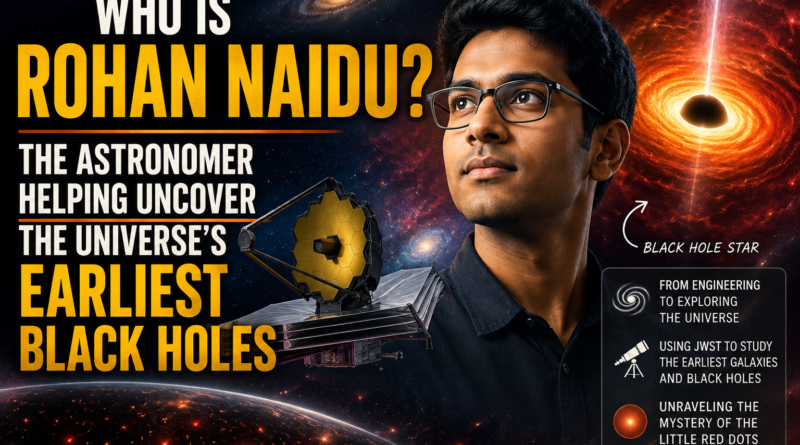
Who Is Rohan Naidu? The Astronomer Helping Uncover the Universe’s Earliest Black Holes
Rohan Naidu is an astronomer whose research is helping scientists investigate some of the most mysterious objects in the early universe. His latest work focuses on a strange cosmic object known as a “black hole star”—a possible new type of astrophysical object that could provide clues about how the universe’s earliest massive black holes formed.
Naidu’s journey has also attracted attention because he left engineering at the age of 18 before pursuing astronomy, eventually becoming a researcher working at the forefront of early-universe studies.
Who Is Rohan Naidu?
Rohan P. Naidu is an astronomer who studies the first stars, galaxies and black holes that formed after the Big Bang.
His research involves some of the most distant objects observable by modern telescopes. By studying light that has travelled billions of years to reach Earth, astronomers can examine what the universe looked like during its earliest stages.
Naidu has been involved in research using the James Webb Space Telescope (JWST), which has transformed scientists’ ability to study the distant universe.
What Is Rohan Naidu Famous For?
Naidu is currently receiving attention for research into a mysterious object called MoM-BH-1*.
The object was observed by the James Webb Space Telescope and appears to be an exceptionally bright red source from a time when the universe was only about 660 million years old. Researchers propose that it could be a black hole surrounded by an enormous envelope of dense gas.
The research describes this unusual configuration as a “black hole star.”
What Is a Black Hole Star?
A black hole star is a proposed cosmic object that combines characteristics normally associated with a star and a black hole.
At its centre could be a rapidly growing black hole, while an enormous cloud of dense gas surrounds it.
The gas could make the object appear more like a bright star when viewed from Earth, even though much of its energy could ultimately be produced by material falling toward the black hole.
Researchers believe this type of object could potentially explain some of the mysterious “little red dots” discovered in observations of the early universe.
How Was the Black Hole Star Discovered?
The object was identified using observations from NASA’s James Webb Space Telescope.
JWST is particularly useful for this type of research because it observes infrared wavelengths, allowing scientists to study extremely distant and ancient objects.
MoM-BH*-1 appears as an unusually bright red object. Researchers analysed its light and developed models to determine what could produce its unusual characteristics.
The findings suggest that the object may contain a black hole surrounded by dense, relatively pristine gas.
How Old Is This Cosmic Object?
MoM-BH*-1 dates to approximately 660 million years after the Big Bang.
That makes it extraordinarily old from our perspective and places it in the period known as cosmic dawn, when some of the earliest stars and galaxies were forming.
Studying an object from this period gives scientists an opportunity to investigate conditions in the universe when it was less than a billion years old.
Why Are Early Black Holes a Mystery?
Scientists have discovered evidence of extremely massive black holes surprisingly early in cosmic history.
The problem is that conventional theories of black-hole growth can struggle to explain how some black holes became billions of times more massive than the Sun within the first several hundred million years of the universe.
The discovery of possible black-hole stars could offer another piece of the puzzle.
If massive black holes could begin growing inside enormous clouds of gas, their early development might have followed a different path from the growth of ordinary stellar black holes.
What Are the “Little Red Dots”?
The James Webb Space Telescope has detected numerous small, bright and unusually red objects in the distant universe.
Astronomers have informally called them “little red dots.”
Their nature has been debated because some of their characteristics do not fit neatly into traditional categories such as ordinary galaxies or typical active galactic nuclei.
The black hole star model offers one possible explanation: these objects could represent black holes embedded within dense gas during an early stage of cosmic evolution.
What Does Rohan Naidu’s Research Suggest?
The research suggests that a black hole surrounded by dense gas could produce the unusual light pattern observed from MoM-BH*-1.
In this scenario:
- A massive black hole exists at the centre.
- The black hole rapidly accretes surrounding material.
- Dense hydrogen-rich gas surrounds the central black hole.
- The gas absorbs and reprocesses some of the light.
- The entire structure can appear as an unusually bright red object.
This could help scientists understand how some of the earliest massive black holes emerged and grew.
Why Is the Discovery Important?
The significance goes beyond one unusual object.
If additional observations confirm that black hole stars existed during cosmic dawn, they could help explain how supermassive black holes appeared so early in the universe.
The discovery could also provide a possible explanation for at least some of JWST’s mysterious little red dots.
Rohan Naidu’s Journey From Engineering to Astronomy
Naidu’s career path is another reason his story has attracted attention.
He reportedly left engineering at 18 and moved toward astronomy, eventually developing a research career focused on the earliest stages of cosmic history.
His journey demonstrates that scientific careers do not necessarily follow a conventional path.
Today, his research is focused on questions that could change scientists’ understanding of how the first galaxies and black holes formed.
What Is the James Webb Space Telescope’s Role?
The James Webb Space Telescope has become a crucial instrument for studying the early universe.
Its ability to observe infrared light allows researchers to investigate extremely distant objects whose light has been stretched by the expansion of the universe.
Without JWST’s sensitivity, objects such as MoM-BH*-1 would be extraordinarily difficult to study.
The telescope’s observations are therefore helping astronomers move from theoretical predictions toward direct evidence about the universe’s earliest structures.
Could Black Hole Stars Explain Supermassive Black Holes?
Possibly, but scientists are still investigating this idea.
The current research provides evidence that MoM-BH*-1 could be consistent with a black hole embedded in dense gas. It does not mean that scientists have definitively established that all early supermassive black holes formed this way.
Further observations will be needed to determine whether black hole stars were common and whether they played a major role in the growth of early supermassive black holes.
What Happens Next?
Scientists will likely search for more objects with characteristics similar to MoM-BH*-1.
Finding additional black hole stars would make the theory stronger and could reveal whether they represent a broader population of objects in the early universe.
Future observations could also help determine:
- How common black hole stars were
- How long they survived
- How massive their central black holes were
- How they interacted with surrounding galaxies
- Whether they eventually evolved into ordinary supermassive black holes
Rohan Naidu and the Future of Early-Universe Research
Rohan Naidu’s work highlights how rapidly astronomy is changing.
The James Webb Space Telescope is revealing objects from periods of cosmic history that were previously difficult to observe, while researchers are developing new models to explain what they are seeing.
The possible discovery of a black hole star is particularly exciting because it could connect two major mysteries: the unusual little red dots observed by JWST and the surprisingly early appearance of massive black holes.
Frequently Asked Questions
Who is Rohan Naidu?
Rohan P. Naidu is an astronomer who studies the first stars, galaxies and black holes formed after the Big Bang.
What did Rohan Naidu discover?
Naidu led research on MoM-BH-1*, an unusual early-universe object that may be a black hole surrounded by dense gas and has been described as a possible “black hole star.”
What is a black hole star?
A black hole star is a proposed object in which a black hole is surrounded by a huge envelope of dense gas, causing the system to appear unusually bright and star-like.
How old is MoM-BH*-1?
The object dates to approximately 660 million years after the Big Bang.
What are little red dots?
Little red dots are small, bright and unusually red objects detected by the James Webb Space Telescope in the early universe. Their exact nature has been an active area of research.
Why are early black holes important?
They could help explain how the first supermassive black holes grew to enormous sizes when the universe was still very young.
Did Rohan Naidu study engineering?
Yes. His career story includes leaving engineering at age 18 before moving toward astronomy.
Bottom Line
Rohan Naidu is helping scientists investigate one of astronomy’s biggest mysteries: how the universe’s earliest massive black holes formed and grew.
His research into MoM-BH*-1 points to the possibility of a previously unrecognised type of cosmic object—a black hole star consisting of a black hole surrounded by dense gas.
If future observations confirm the model, the discovery could provide an important clue to the origin of the earliest supermassive black holes and help explain the mysterious red objects being observed by the James Webb Space Telescope.