
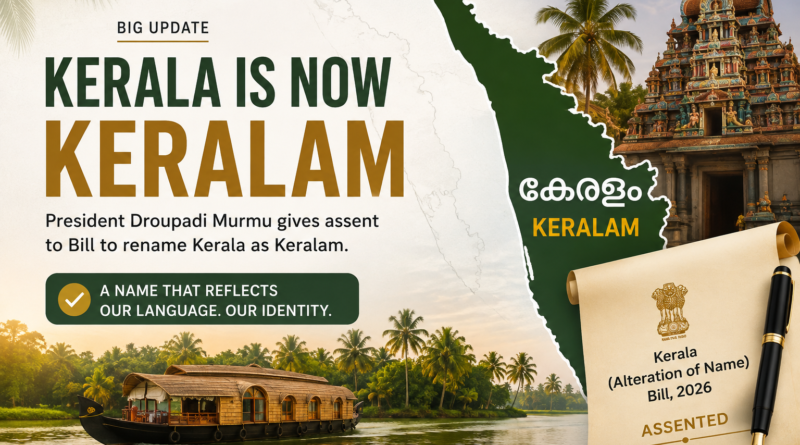
Kerala Is Now Keralam: President Murmu Gives Assent to State Name Change Bill
Kerala is officially set to be known as Keralam after President Droupadi Murmu gave her assent to the Kerala (Alteration of Name) Bill, 2026. The approval completes the parliamentary process for changing the state’s official name from Kerala to Keralam.
The change reflects the state’s Malayalam name and follows a process that began with a resolution passed by the Kerala Legislative Assembly in 2024.
Why Is Kerala Being Renamed Keralam?
The name “Keralam” is the Malayalam name traditionally used for the state.
The Kerala Legislative Assembly had unanimously supported changing the constitutional name from Kerala to Keralam, arguing that the state’s official name should reflect its Malayalam linguistic and cultural identity.
The proposal was subsequently taken up by the Union government and placed through the constitutional procedure required for changing the name of a state.
When Did Kerala Become Keralam Officially?
President Droupadi Murmu gave her assent to the Kerala (Alteration of Name) Bill, 2026, on August 17, 2026.
With presidential assent, the legislation became law and provides for the state to be officially known as Keralam.
The Bill had already cleared both Houses of Parliament before receiving the President’s approval.
What Does the Name Change Mean?
The legislation provides for the name “Kerala” to be replaced by “Keralam” in the First Schedule of the Constitution.
This is important because the First Schedule contains the names and territories of India’s states and Union territories.
The change therefore goes beyond simply changing how the state is referred to in everyday conversation. It establishes Keralam as the state’s constitutional name.
Why Was the Name Change Proposed?
The main reason behind the proposal is linguistic and cultural identity.
In Malayalam, the state is known as Keralam (കേരളം). The state was also created as a Malayalam-speaking state during India’s linguistic reorganisation of states.
The 2024 Assembly resolution argued that the constitutional name should reflect the Malayalam form of the state’s name.
The move has therefore been described as an effort to bring the state’s constitutional identity closer to its local linguistic usage.
When Did the Kerala Assembly Approve the Proposal?
The Kerala Legislative Assembly passed a resolution seeking the name change in June 2024.
The state government subsequently forwarded the resolution to the Union government, beginning the formal constitutional process for changing the state’s name.
The proposal was later referred back to the state legislature for its views, after which the Assembly supported the change.
How Does India Change the Name of a State?
Changing the name of an Indian state requires a constitutional process under Article 3 of the Constitution.
Broadly, the process involves:
- A proposal for changing the state’s name.
- Presidential recommendation for introducing the Bill in Parliament.
- Reference of the proposal to the concerned state legislature for its views.
- Consideration and passage of the Bill by Parliament.
- Presidential assent.
- Amendment of the relevant constitutional provisions.
The Kerala name-change process followed this constitutional framework.
Did Parliament Approve the Keralam Bill?
Yes.
The Lok Sabha passed the Kerala (Alteration of Name) Bill, 2026, on August 11, followed by the Rajya Sabha on August 12.
President Murmu then gave her assent on August 17, completing the legislative process.
Will People Still Call It Kerala?
The state’s constitutional name is now being changed to Keralam, but the transition to the new name will involve updating official records and references.
Government departments and other institutions will need to gradually update documents, databases, signage and other official materials.
The change does not mean that the state’s geography, districts, cities or administrative structure are being altered. It is primarily an official name change.
What Will Change After Kerala Becomes Keralam?
The name change is expected to require updates across a wide range of government and administrative systems.
These could include:
- Government documents
- Official websites
- Legal records
- Maps
- Road and railway signage
- Government databases
- Administrative forms
- Public-sector records
- Educational and institutional documents
The transition is expected to take time because the name appears across numerous physical and digital systems.
Is Keralam a New State?
No.
Keralam is not a newly created state.
It is the same state that was previously officially known as Kerala. The change concerns the state’s official name, not its territory or administrative status.
What Does Keralam Mean?
Keralam is the Malayalam name of the state.
The name is widely used in Malayalam-language contexts and is familiar to residents of the state.
The official name change therefore brings the constitutional English name closer to the state’s native linguistic form.
Why Is the Change Considered Significant?
The decision has significance beyond administration.
For supporters, changing Kerala to Keralam represents:
- Recognition of Malayalam linguistic identity
- Greater consistency between local and constitutional terminology
- Recognition of the state’s cultural heritage
- Restoration of the name commonly used in Malayalam
The move also follows a broader pattern in India where places have adopted names closer to their traditional or local forms.
Will the Name Change Affect Tourism?
For tourists, there should be little immediate practical impact.
The state’s destinations, airports, railway stations, beaches, hill stations and other attractions remain unchanged.
Over time, however, travellers may notice Keralam appearing on official documents, signs and government platforms as the new name becomes standardised.
What Happens to the Word ‘Kerala’?
The word Kerala will continue to be familiar and may remain in historical references, existing publications and informal usage during the transition.
However, the constitutional and official name of the state will be Keralam following the enactment of the name-change legislation.
Kerala to Keralam: Key Facts
| Detail | Information |
| Old official name | Kerala |
| New official name | Keralam |
| Malayalam name | കേരളം |
| Bill | Kerala (Alteration of Name) Bill, 2026 |
| Assembly resolution | 2024 |
| Lok Sabha approval | August 11, 2026 |
| Rajya Sabha approval | August 12, 2026 |
| Presidential assent | August 17, 2026 |
| President | Droupadi Murmu |
| Constitutional provision | Article 3 |
| Constitutional change | First Schedule |
Frequently Asked Questions
Is Kerala officially renamed Keralam?
Yes. President Droupadi Murmu gave assent to the Kerala (Alteration of Name) Bill, 2026, making the legislation law and providing for the state’s official name to be changed to Keralam.
When was Kerala renamed Keralam?
President Murmu gave her assent to the Bill on August 17, 2026.
Why is Kerala being renamed Keralam?
The change is intended to align the state’s constitutional name with its Malayalam name, Keralam, and recognise its linguistic and cultural identity.
What is the new name of Kerala?
The new official name is Keralam.
Did the Kerala Assembly support the name change?
Yes. The Kerala Legislative Assembly passed a resolution supporting the change in 2024.
Did Parliament pass the Keralam Bill?
Yes. The Lok Sabha passed the Bill on August 11, 2026, and the Rajya Sabha passed it on August 12, 2026.
Does the name change create a new state?
No. Kerala and Keralam refer to the same state. Only its official name is being changed.
Will Kerala’s borders change?
No. The name-change legislation does not create new territory or alter the state’s boundaries.
Bottom Line
Kerala is officially moving to the name Keralam after President Droupadi Murmu gave her assent to the Kerala (Alteration of Name) Bill, 2026.
The change follows the Kerala Legislative Assembly’s 2024 resolution and Parliament’s approval of the Bill in August 2026. The new name reflects the state’s Malayalam identity and requires the name “Kerala” to be replaced with “Keralam” in the First Schedule of the Constitution.
For residents and visitors, the state itself remains unchanged. What changes is the official name by which it is recognised in India’s constitutional and administrative records.