
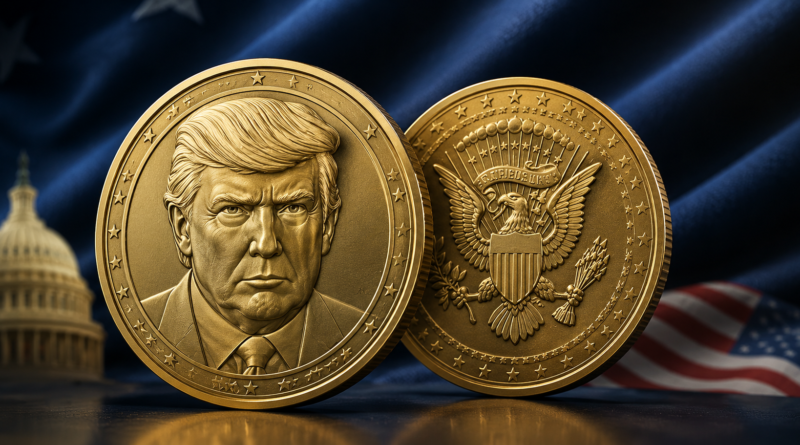
$1 Trump Coin Is Real Money — But You Probably Won’t Want to Spend It
The U.S. Mint has released a gold-colored $1 coin featuring President Donald Trump for America’s 250th anniversary. It is legal tender, but collectors are paying far more than its face value.
A new piece of American currency featuring President Donald Trump has officially entered the picture — and it is already generating attention far beyond the world of coin collecting.
The U.S. Mint began selling its new 2026 Semiquincentennial President Donald J. Trump coin $1 on September 2, marking the nation’s 250th anniversary. The coin carries a $1 face value and is legally recognized as money, but the Mint is selling it to collectors at a substantial premium.
That creates an unusual situation: the coin is worth $1 as currency, but you pay more than $1 to obtain one directly from the Mint.
What Does the New Trump Coin Look Like?
The coin features Trump’s portrait on the front, accompanied by the inscriptions “LIBERTY” and “1776–2026.”
The reverse carries the Great Seal of the United States, including the eagle and the inscription “E PLURIBUS UNUM.” The design was created as part of the commemorative coinage surrounding America’s 250th anniversary.
Despite its gold-like appearance, the coin is not made of gold.
The U.S. Mint says the coin uses a copper-based composition containing zinc, manganese and nickel, giving it its distinctive golden appearance. The coin weighs approximately 0.286 ounces.
Is Trump’s $1 Coin Actually Legal Tender?
Yes.
This is one of the most interesting aspects of the new coin.
The coin carries a legal face value of $1, meaning it is recognized as legal tender under federal law. It can theoretically be used for payments and other obligations where U.S. currency is accepted.
However, being legal tender does not mean every business has to accept it for an ordinary purchase.
A private business can generally choose which forms of payment it accepts. So while you could theoretically try to hand over a Trump dollar to pay for a purchase, a retailer could refuse it.
That makes the coin much more interesting as a collectible than as practical everyday spending money.
Why Does a $1 Coin Cost More Than $1?
This is where the collectible aspect comes in.
The U.S. Mint is selling the coins in 25-coin rolls for $61 and 100-coin bags for $154.50. That works out to approximately $2.44 per coin in a 25-coin roll and $1.55 per coin in a 100-coin bag.
The difference between the face value and selling price represents the premium associated with producing and marketing the commemorative issue rather than the monetary value of the metal itself.
So if someone buys a 25-coin roll for $61 and immediately spends all 25 coins at face value, they would receive only $25 worth of spending power.
In other words, spending the coins would mean losing the premium paid to acquire them.
Trump Coin Is Already Drawing Collector Interest
The unusual design and historical significance have helped generate immediate interest.
The Mint has produced a limited number of the coins for the initial release, while special versions featuring a “July 4th” privy mark were also struck. The Mint says 250,000 of these special-issue coins were struck on July 4 and randomly placed in rolls and bags.
The coins have also reportedly sold rapidly, with initial inventory becoming difficult to obtain shortly after release.
That scarcity could add to collector interest, although it does not guarantee that the coins will appreciate in value.
Why Is Trump’s Image on a U.S. Coin Controversial?
The coin has also sparked a legal and historical debate.
For more than a century, federal law and longstanding American tradition have generally restricted the appearance of living presidents on U.S. currency.
Trump’s coin is therefore unusual because he is a sitting president whose likeness appears on a U.S. coin while he is still alive and in office.
The Treasury has defended the issue by pointing to the legislation authorizing special semiquincentennial coinage. Supporters also point to historical precedent, including the appearance of President Calvin Coolidge on a 1926 commemorative coin celebrating America’s 150th anniversary.
Critics, however, have questioned whether the new coin fits within existing restrictions concerning presidential portraits on currency.
The dispute makes the coin historically notable even before considering its potential value to collectors.
Trump Is Not the First Living President to Appear on a Coin
Although the new Trump dollar is being described as an unprecedented development in modern American currency, there is a historical exception.
President Calvin Coolidge appeared on a commemorative half dollar issued in 1926 for the Sesquicentennial of American independence.
That precedent is one reason the Treasury has argued that Trump’s commemorative coin can be issued under the special anniversary legislation.
The Trump coin nevertheless stands out because it is a $1 piece designed with a circulating finish and is being made available through the Mint while Trump remains president.
Could You Find One in Your Change?
Potentially, yes.
The U.S. Mint has described the coins as being part of the circulating coin program, although the initial products sold directly to collectors are rolls and bags.
The Mint has also said that the coins may be used as legal tender, meaning that someone who receives one in a transaction could technically spend it at face value.
But because collectors may attach a premium to certain examples, finding one in everyday change could make it worth examining before spending it.
Special July 4-marked examples could attract particular collector interest, although their eventual market value will depend on factors such as demand, condition and availability.
A Coin Worth $1 — But Sold for More
The Trump $1 coin illustrates an important distinction between face value and collector value.
Its official monetary value is $1. That is the amount it represents as legal tender.
But its collectible value can be higher because people may be willing to pay more for its historical significance, limited availability or special characteristics.
That does not mean every Trump dollar will become a valuable collectible. Like other commemorative coins, future prices will depend on supply, demand and collector interest.
For now, however, the coin has already achieved something unusual: it has become a piece of official U.S. money that is simultaneously being marketed as a collectible.
The Bottom Line
Trump’s new $1 coin is more than another addition to America’s change.
It commemorates the 250th anniversary of the United States, features a sitting president, carries a $1 legal-tender value and comes with a collector premium when purchased directly from the Mint.
You can spend it.
But if you paid $61 for a roll of 25, doing so would turn a $61 purchase into $25 of face-value currency.
That is why, for most buyers, the Trump dollar is likely to spend more time in a collection than in a cash register.