
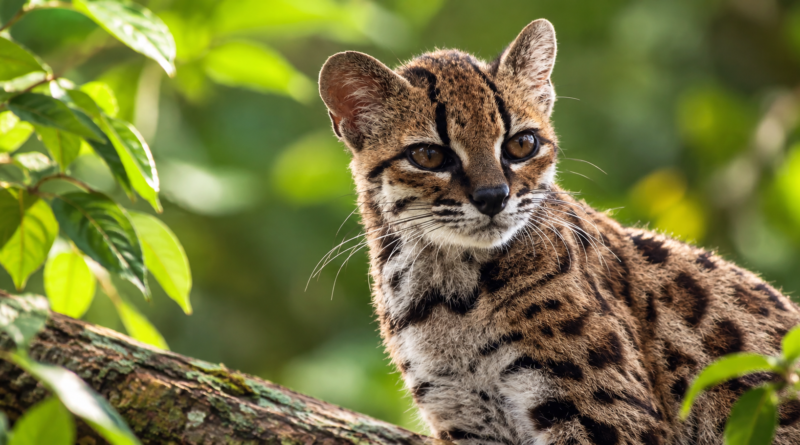
New Tiger Cat Species Discovered in Bolivia After More Than 100 Years
Scientists have identified a previously unknown species of wild cat in Bolivia, marking the first time in more than a century that a new living feline species has been formally named and described.
Named Leopardus tilcayo, the tiny spotted cat was found in Bolivia’s Yungas cloud forests. The animal is only around 46 centimetres long and weighs about 1.4 kilograms, making it smaller than an average domestic cat.
The discovery was made possible through a combination of field observations, museum specimens and genetic analysis, revealing that what scientists had considered one group of tiger cats actually contains several genetically distinct species.
Meet Leopardus tilcayo, the New Tiger Cat
The newly identified animal belongs to the tiger cat group, a collection of small wild cats found across parts of Central and South America.
Leopardus tilcayo has a light-brown coat covered with dark, irregular rosettes. It also has rounded ears, long whiskers and a slender body. Its appearance is similar to other tiger cats, which helped keep the species hidden from scientific recognition for years.
The species is locally known as Tilcayo, a name that was retained in its scientific designation.
Scientists currently know very little about its behaviour in the wild. Camera-trap evidence suggests the cat may be more active at night, while analysis of scat indicates that small rodents could form part of its diet.
A Cat That Was Mistaken for an Ordinary Kitten
The story of the discovery is unusual.
One of the key animals in the research is a male cat now living at the Senda Verde wildlife refuge in Bolivia. The animal had originally been found in the forest and was taken in by a local family, who initially believed they had found a domestic kitten.
As the animal grew, however, its appearance and behaviour suggested that it was a wild cat.
Bolivian biologist and National Geographic Explorer Paola Nogales-Ascarrunz encountered the animal while volunteering at the sanctuary. She noticed that its markings did not appear to match the known descriptions of tiger cats.
That observation eventually led researchers to investigate its genetic identity.
DNA Revealed a Hidden Species
The researchers compared genetic material from 38 tiger cats collected across several parts of South America, including museum specimens.
The analysis showed that tiger cats previously grouped together actually represent five genetically distinct species.
The Bolivian cat was genetically different enough to be recognised as a separate species. Researchers estimate that the lineage leading to Leopardus tilcayo separated from other tiger cats around 1.4 million years ago.
The findings were published in the scientific journal Current Biology.
Why Did Scientists Take So Long to Identify It?
One reason is that tiger cats are what scientists call cryptic species.
These are species that can look extremely similar despite being genetically distinct. In the case of tiger cats, differences in coat patterns and body characteristics can be subtle, making it difficult to determine species boundaries based only on appearance.
There are also relatively few museum specimens and documented sightings of some of these animals.
Researchers say the Bolivian cat’s unusual characteristics prompted the question of which tiger cat actually lives in Bolivia’s Yungas forests.
Genetic research eventually provided the answer.
Only One Living Individual Is Confirmed
Despite the discovery, scientists still have many unanswered questions.
At present, only one living individual of Leopardus tilcayo has been confirmed. Researchers believe other members of the species are likely to exist in the wild, but they do not yet know how large the population is.
The Yungas region is difficult to study because of its mountainous terrain and dense cloud forests.
This means researchers will need more field surveys, camera-trap studies and genetic sampling to determine how widespread the species really is.
The Discovery Could Change Tiger Cat Conservation
Identifying a new species is more than a scientific naming exercise.
If a population previously treated as part of a broader species is actually a separate species, its conservation needs may also need to be assessed separately.
Researchers say tiger cats face threats including deforestation, habitat loss and illegal hunting. The newly identified species was not included in earlier conservation assessments because scientists did not previously know that it existed as a distinct species.
Scientists have shared their findings with conservation authorities, including the International Union for Conservation of Nature, for consideration in future assessments.
Another Tiger Cat Subspecies Found in Peru
The research produced another significant finding.
Scientists also identified a previously unrecognised tiger cat subspecies in Peru’s Yungas region and named it Leopardus tigrinus antisuyo.
The name refers to Antisuyu, one of the regions of the former Inca Empire that included the area where the animals live.
Together, the findings suggest that the diversity of South America’s small wild cats has been underestimated.
A Reminder That New Species Are Still Waiting to Be Found
The discovery of Leopardus tilcayo challenges the idea that scientists have already documented most of the world’s larger and more recognisable mammals.
The cat was not found in an unexplored corner of the planet. Instead, it was hiding within a group of animals that scientists already knew about, separated by subtle physical characteristics and genetic differences.
Researchers say the discovery demonstrates how much biodiversity may still remain undocumented, particularly in poorly studied ecosystems such as Bolivia’s Yungas forests.
The Yungas forms part of the Andes-Amazon region and supports a wide variety of species. At the same time, the ecosystem faces pressure from activities such as deforestation, agriculture and mining.
What Happens Next?
For scientists, identifying Leopardus tilcayo is only the beginning.
Researchers now need to find out how many of these cats exist, where they live, what they eat, how they reproduce and how they interact with other tiger cat species.
Further fieldwork could also reveal whether the species has a much wider distribution than currently known.
For now, however, one small spotted cat from Bolivia has made a major addition to the world’s feline family — becoming the first living cat species formally described in more than 100 years.
And the discovery suggests that even in an age of advanced genetics and global scientific exploration, nature may still have a few remarkable secrets left to reveal.