
Himalayas Near Tipping Point as Glaciers Melt 65% Faster, Putting India’s Water and Economy at Risk
Himalayan glaciers are losing mass at an increasingly rapid rate, raising concerns over water security, floods, landslides and the future of millions of people across South Asia. A new report warns that the region could approach a critical “peak water” point by mid-century.
The Himalayas are approaching a dangerous environmental threshold as glaciers continue to lose ice at a much faster rate than in the past, threatening water supplies, livelihoods and critical infrastructure across South Asia.
A new study led by sustainability consultancy Systemiq, in partnership with the Integrated Mountain Initiative, the International Centre for Integrated Mountain Development (ICIMOD) and India’s G.B. Pant National Institute of Himalayan Environment, has warned that Himalayan glaciers are losing mass 65% faster than they were a decade ago.
The findings come at a time when the region is already witnessing the consequences of a rapidly changing mountain environment. A glacier collapse near the Nepal-Tibet border on August 26 triggered devastating flash floods and landslides, with more than 1,300 people confirmed dead and thousands still missing across Nepal and Tibet, according to Reuters.
Why Are the Himalayas Approaching a Tipping Point?
The concern is not simply that glaciers are melting. Scientists and researchers are increasingly focused on what happens as the Himalayan ice reserves become smaller and less capable of regulating river flows.
Glaciers act as natural water reservoirs, storing water as ice and releasing it gradually. Faster melting can initially increase downstream water supplies. But once glaciers lose enough mass, that additional meltwater can decline.
This transition is known as “peak water” — the point at which glacier-fed river flows reach their maximum before beginning to fall as the ice reserves shrink.
The new research suggests that many Himalayan river basins could approach this stage around the middle of the century. A sustained decline in glacier-fed water would have major implications for agriculture, cities, hydropower and communities that depend on predictable water supplies.
India Faces a Major Water Security Risk
For India, the warning carries particular significance because Himalayan rivers support agriculture, drinking water supplies, hydropower and economic activity across large parts of the country.
The report estimates that the Himalayan system underpins more than 20% of India’s GDP, highlighting how environmental changes in the mountains could have consequences far beyond the Himalayan states.
Changes in the timing and availability of river water could affect irrigation and electricity generation, while communities dependent on farming, tourism and other local economic activities could face increasing pressure.
The risks could become particularly severe if water availability becomes less predictable at the same time as extreme weather events become more damaging.
Nearly 200 Glacial Lakes in India Identified as High Risk
One of the immediate concerns is the growing number of unstable glacial lakes.
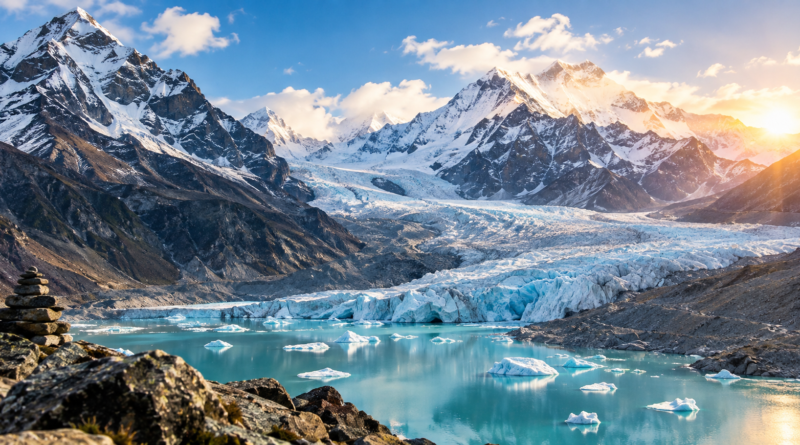
As glaciers retreat, meltwater can accumulate behind natural barriers made from loose rocks and ice. These lakes can become unstable and, if a barrier fails, release enormous volumes of water downstream in what is known as a glacial lake outburst flood (GLOF).
The study identified close to 200 high-risk glacial lakes in India, including 56 classified as very high risk. Millions of people living downstream could potentially be exposed to sudden flooding from such events.
The recent disaster near the Nepal-Tibet border has highlighted how quickly hazards in the high mountains can cascade into devastating floods and infrastructure damage.
The Himalayan Monitoring Gap Is Alarming
Another major concern is the limited ability to continuously monitor the region’s glaciers.
The Hindu Kush-Himalaya region is estimated to contain around 40,000 glaciers, but only 21 are currently monitored on the ground, according to the report cited by Reuters and Times of India.
That leaves a significant monitoring gap.
More comprehensive monitoring could help researchers identify changes in glaciers and glacial lakes earlier, improve flood forecasting and strengthen early-warning systems for communities living downstream.
With glaciers changing rapidly, the lack of detailed ground-level observations could make it harder to anticipate emerging hazards.
Himalayan Region Accounts for a Large Share of India’s Natural Disasters
The report also highlights the disproportionate disaster risk faced by the Himalayan region.
Although the Himalayan region covers around 18% of India’s land area, it accounts for roughly 35% of the country’s natural disasters, according to the findings reported by Reuters and Times of India.
This vulnerability comes from a combination of steep terrain, extreme weather, fragile mountain ecosystems, glacier retreat and expanding infrastructure.
As the climate changes, these factors can interact with one another, potentially increasing the likelihood and severity of floods, landslides and other mountain hazards.
What Happens After “Peak Water”?
The phrase “peak water” does not mean that Himalayan rivers will suddenly dry up.
Instead, it refers to a longer-term shift. As glaciers initially melt faster, more water may enter downstream river systems. But after the glaciers pass their maximum contribution, shrinking ice reserves mean less meltwater is available.
That could create increasing water stress, particularly during periods when rainfall or monsoon supplies are insufficient.
For agriculture, this could affect irrigation. For hydropower projects, changing river flows could complicate electricity generation. Cities and communities dependent on Himalayan river systems could also face greater uncertainty over water availability.
Flood Risk May Rise Before Water Supplies Decline
The Himalayan crisis therefore presents a complicated paradox.
In the near term, accelerated melting can increase water flows and contribute to the formation and expansion of glacial lakes. This can raise the risk of floods and landslides.
Over the longer term, continued glacier loss could reduce the amount of glacier-fed water entering rivers.
In other words, communities could face greater flood risk today while also confronting potential water shortages in the future.
This combination makes adaptation and early-warning systems increasingly important.
Recent Glacier Collapse Shows the Stakes
The warnings come shortly after a devastating glacier collapse along the Nepal-Tibet border.
The August 26 disaster sent cascading landslides and flash floods through valleys, killing at least 1,300 people and leaving more than 5,300 missing across Nepal and China’s Tibet region, according to Reuters. The disaster also damaged roads, bridges and hydropower infrastructure.
The event has added urgency to calls for better glacier monitoring, disaster preparedness and regional cooperation.
Mountain hazards do not follow political borders. Changes in the Himalayas can affect river systems and communities across several countries.
What Needs to Be Done?
The latest findings underline the need for stronger climate adaptation across the Himalayan region.
Key priorities include:
- Expanding ground-based glacier monitoring.
- Improving satellite and remote-sensing systems.
- Closely monitoring high-risk glacial lakes.
- Developing stronger early-warning systems.
- Improving disaster preparedness in downstream communities.
- Building climate-resilient roads, bridges and hydropower infrastructure.
- Strengthening cooperation between countries sharing Himalayan river systems.
- Reducing the drivers of glacier loss and regional warming.
The scale of the challenge means that monitoring alone will not be enough. Governments will also need to prepare communities and infrastructure for both increasing short-term hazards and longer-term changes in water availability.
A Warning for India and South Asia
The latest research presents the Himalayas as more than a mountain or environmental story. The region is a critical part of South Asia’s water, agricultural, energy and economic systems.
With glaciers losing mass 65% faster than a decade ago, the warning signs are becoming increasingly difficult to ignore.
The approaching “peak water” transition could reshape the availability of water across the region, while unstable glacial lakes and changing mountain conditions could increase disaster risks.
For India, where the Himalayan system supports a significant share of economic activity and millions of people depend directly or indirectly on its rivers, protecting the mountains is also a matter of water security, economic resilience and public safety.
The message from the latest research is clear: the window for improving monitoring, preparedness and climate resilience is narrowing as the Himalayas move closer to a critical tipping point.