
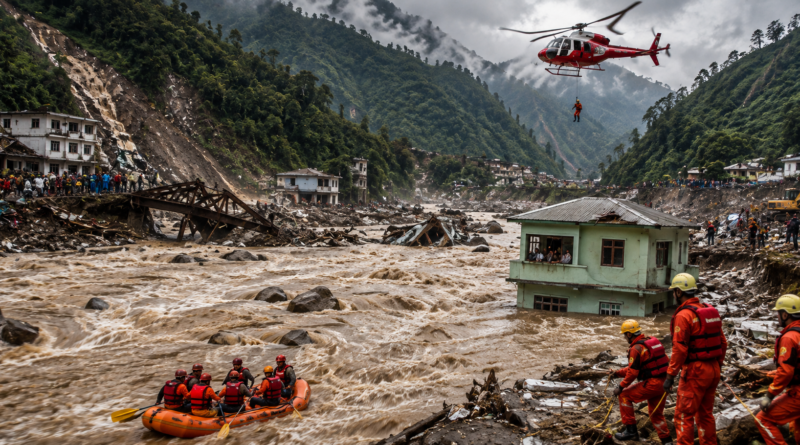
Nepal Flash Floods 2026: Death Toll Rises as Rescue Operations Intensify Amid Fresh Flood Threat
A catastrophic Nepal flash flood and landslide disaster along the Nepal-Tibet border has left hundreds dead and thousands missing, triggering an intense search-and-rescue operation across some of the Himalayan region’s most difficult terrain.
The disaster struck on August 26, 2026, after a glacier collapse and massive flow of water, ice, mud and debris swept through areas of Nepal and Tibet. The flooding destroyed homes, roads, bridges, border infrastructure and other critical facilities.
By August 29, reported figures had risen rapidly, with Nepal’s death toll reaching 626, while thousands remained unaccounted for across Nepal and Tibet.
What Happened in Nepal?
The disaster began in the Himalayan region near the Nepal-China border, where a glacier-related event triggered an enormous surge of water and debris.
The resulting flood travelled through river valleys, carrying rocks, mud and other debris and overwhelming settlements and infrastructure.
The affected areas include parts of Rasuwa and neighbouring districts, while the disaster also severely affected the Gyirong area of Tibet.
The force of the water was so strong that buildings, vehicles, bridges and other structures were swept away within minutes.
Death Toll and Missing Persons
The casualty figures have continued to change as rescue teams reach previously inaccessible areas.
As of August 29, reports indicated that at least 626 people had died, while the number of missing people across Nepal and Tibet had climbed to around 3,000.
Earlier reports had put Nepal’s confirmed deaths at 579 with 1,924 people missing, showing how quickly the toll has been changing as authorities verify information and recover victims.
The situation remains fluid, and authorities are continuing to update casualty and missing-person figures.
Hundreds of Indians Among the Missing
The disaster has caused particular concern in India because many Indian nationals were travelling through the region, including pilgrims visiting the Kailash Mansarovar area.
Indian government figures reported on August 29 indicated that 320 Indians and around 100 people of Indian origin were missing, according to reports.
Indian authorities have been coordinating with Nepal and China to identify missing citizens and assist those stranded or rescued.
At least several Indian nationals have also been rescued, while authorities continue efforts to establish contact with people whose whereabouts remain unknown.
Rescue Operations Intensify
Nepalese authorities have deployed large numbers of security personnel and rescue workers to affected areas.
Helicopters are being used to reach isolated locations, evacuate survivors and transport relief supplies. More than 3,700 people had been rescued in Nepal according to earlier official reporting.
However, the rescue operation remains extremely challenging.
Collapsed bridges, damaged roads, thick layers of mud, destroyed communications infrastructure and continuing bad weather are making it difficult for teams to reach some of the worst-hit locations.
Fear of More Flooding
The disaster has not completely ended.
Authorities remain concerned about unstable glacial lakes and water accumulating behind debris blockages, which could produce additional flooding if those natural barriers fail.
This has forced authorities to maintain warnings for communities located downstream and monitor vulnerable areas closely.
The possibility of additional flooding is particularly dangerous because many roads and bridges have already been damaged, limiting evacuation options.
Damage to Infrastructure
The floods have caused widespread destruction to critical infrastructure.
Bridges, roads, power facilities, communication networks and border facilities have suffered severe damage. The Gyirong border crossing, an important route between Nepal and Tibet, was among the badly affected infrastructure.
In Nepal, rescuers have also been searching locations where people may have become trapped inside tunnels and other structures.
The scale of the destruction means that restoring transportation and communication networks could take considerable time.
India Steps Up Relief Efforts
India has responded by sending relief materials and offering specialised assistance to Nepal.
According to current reports, India has dispatched relief supplies and technical teams, while additional aircraft carrying humanitarian material have been sent to support the affected population.
Indian authorities are also working to locate and assist Indian nationals affected by the disaster.
The response includes coordination between Indian diplomatic officials, Nepalese authorities and agencies involved in rescue operations.
Why Was the Flood So Destructive?
The disaster appears to have been linked to a glacier collapse and subsequent flooding, creating a massive flow of water, ice, rock and mud.
Glacial hazards are a growing concern in the Himalayan region. Rising temperatures can contribute to glacier retreat and the formation or expansion of unstable glacial lakes.
When such a natural barrier fails, enormous quantities of water can suddenly move downstream, producing what is known as a glacial lake outburst flood (GLOF).
The geography of the Himalayas can amplify the impact because narrow valleys can concentrate floodwaters and debris.
Survivors Describe a Terrifying Scene
People who survived the disaster have described the flood as sudden and extremely powerful.
In some areas, residents had only moments to react as water and debris swept through communities.
The destruction has left families searching for missing relatives while survivors face the difficult task of rebuilding their lives after losing homes and belongings.
One particularly striking image from the disaster showed a green house remaining standing amid raging floodwaters, while the family inside was later confirmed safe. The image became a symbol of both the destructive force of the flood and the survival of those caught in its path.
Nepal Requests Technical Assistance
Nepal has indicated that it needs specialised international support in areas such as tunnel rescue operations, infrastructure restoration, communications, DNA identification and forensic services.
The country has also estimated that reconstruction could require billions of dollars as authorities assess the full scale of the damage.
This highlights that the disaster is likely to have consequences well beyond the immediate rescue operation.
Nepal Floods 2026: Key Facts
| Category | Details |
| Disaster | Flash floods and landslides |
| Date | August 26, 2026 |
| Main affected areas | Nepal-Tibet border region |
| Reported Nepal death toll by Aug. 29 | 626 |
| Missing across region | Around 3,000 |
| Indian nationals reported missing | 320 |
| Major cause | Glacier collapse and resulting flood/debris flow |
| Major concerns | Further flooding, damaged infrastructure and difficult access |
| Rescue response | Helicopters, security forces and specialised teams |
| International assistance | India and other countries providing relief and technical support |
Figures remain subject to change as search and rescue operations continue.
A Disaster Still Unfolding
The Nepal-Tibet floods have become one of the Himalayan region’s most devastating disasters in recent years. With hundreds dead, thousands missing and entire communities damaged, the immediate priority remains finding survivors and providing emergency assistance.
At the same time, authorities must monitor unstable glacial lakes and damaged river systems for further flooding.
For families in Nepal, India and other countries waiting for information about missing relatives, the rescue operation is a race against time.
As search teams continue working through mud, debris and damaged infrastructure, Nepal faces both an urgent humanitarian emergency and the enormous challenge of rebuilding after one of the region’s most destructive flood disasters.