
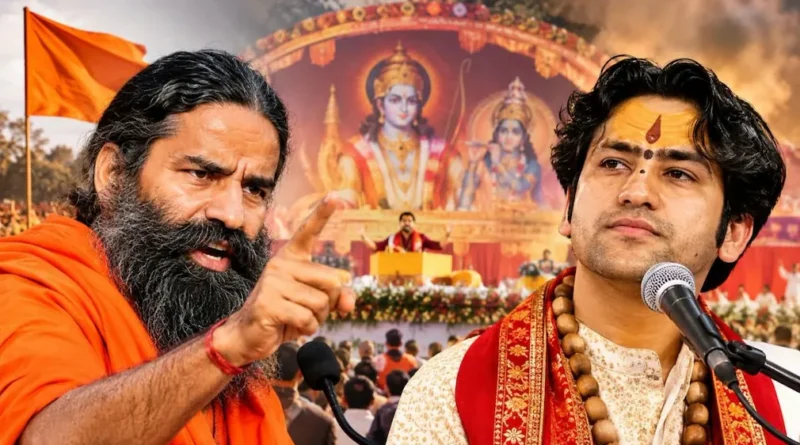
Ramdev Versus Dhirendra Shastri: Behind the Viral Row
The unexpected Ramdev versus Dhirendra Shastri controversy has sparked intense debate across religious and political circles after warm camaraderie quickly turned into sharp public criticism. Just days after sharing a stage in Uttar Pradesh, yoga guru Baba Ramdev launched a scathing attack on Bageshwar Dham chief Dhirendra Krishna Shastri over resurfaced remarks comparing Lord Ram and Lord Krishna.
At the heavily attended Kunda Ram Katha in Uttar Pradesh’s Pratapgarh district, both spiritual leaders displayed visible warmth and mutual respect. However, within a few days, that friendly atmosphere gave way to a war of words that drew reactions from devotees and political parties alike.
What Triggered the Ramdev Versus Dhirendra Shastri Row?
The dispute stems from an older video clip recorded during a religious discourse in Karera, located in Madhya Pradesh’s Shivpuri district. In the viral footage, Shastri appeared to contrast the two revered Hindu deities by calling Lord Ram seedhe (straight) and describing Lord Krishna as tedhe-medhe (crooked), an apparent reference to Krishna’s traditional tribhanga (three-bend) posture.
As the clip circulated widely online, several devotees and religious commentators objected to the comparison and demanded a public retraction. Facing mounting backlash, Shastri issued a video apology, calling his statement an “emotional outburst” and clarifying that he never intended to demean Lord Krishna, whom he deeply reveres.
For more updates on viral controversies and trending religious debates across the country, explore [INTERNAL LINK: our latest coverage on trending Indian news and viral social media moments].
Why Ramdev Criticised Shastri Days After Kunda
What surprised observers most in the Ramdev versus Dhirendra Shastri episode was the timing of Ramdev’s intervention. Despite praising Shastri at the Kunda gathering in Uttar Pradesh—an event hosted by MLA Raghuraj Pratap Singh—Ramdev subsequently rebuked the younger preacher during an appearance in Jamshedpur, Jharkhand.
Key developments surrounding the dispute include:
-
Sharp Reprimand: Ramdev strongly objected to casual comparisons between deities, stressing that strict decorum and scriptural discipline must govern religious discourses.
-
Political Spillover: The controversy gained political traction in Uttar Pradesh, where opposition leaders seized on the remarks to target Shastri’s growing public influence.
-
Peaceful Resolution: Speaking at a katha in Pathankot, Shastri called Ramdev a guardian figure and accepted his criticism as a blessing, prompting Ramdev to declare the matter closed.
The rapid shift from stage-side bonhomie to public censure raised eyebrows among political analysts, especially given Shastri’s rising profile among prominent leaders. Readers following how spiritual figures intersect with state politics can check [INTERNAL LINK: our analysis of religion and politics in Uttar Pradesh].
How the Spiritual Dispute Concluded
Following days of intense media speculation over Ramdev versus Dhirendra Shastri, both leaders moved to defuse tensions and prevent divisions among their followers.
Ultimately, Ramdev clarified that he viewed Shastri like a younger brother and urged supporters on both sides not to prolong the quarrel. While the immediate Ramdev versus Dhirendra Shastri face-off has cooled down, the episode highlights how quickly resurfaced clips can ignite religious and political storms in India.