
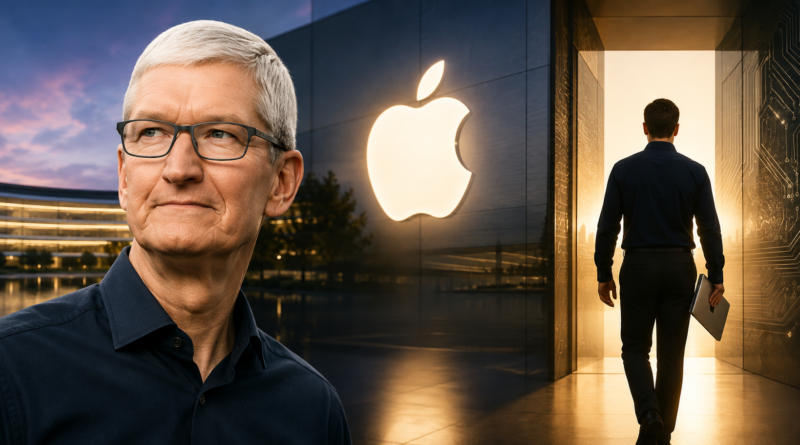
Tim Cook Steps Down as Apple CEO: How He Took Apple From $350 Billion to $4 Trillion
After nearly 15 years at the helm of Apple, Tim Cook is stepping down as CEO, bringing an end to one of the most consequential leadership eras in the company’s history.
Cook took over from Apple co-founder Steve Jobs in August 2011, at a time when Apple was already a technology giant but still heavily associated with Jobs’ extraordinary product vision. Over the following years, Cook transformed the company’s scale, operations and business strategy, helping Apple grow from a roughly $350 billion company into a business valued at around $4 trillion.
His tenure became defined by operational discipline, a massive expansion of Apple’s services business, new product categories and an increasingly powerful ecosystem.
Tim Cook’s Final Day as Apple CEO
Tim Cook’s final day as Apple CEO comes on August 31, 2026, marking the end of almost 15 years of leadership.
Cook will be succeeded as CEO by John Ternus, Apple’s senior vice president of Hardware Engineering. Ternus has been closely involved in Apple’s product development and is expected to carry forward many of the company’s existing strategies.
Cook, meanwhile, is expected to remain connected to Apple in a different capacity following his departure from the CEO position.
His succession represents one of the biggest leadership transitions at Apple since Jobs handed the company’s reins to Cook.
From Steve Jobs’ Successor to Apple’s Longest-Serving CEO
When Cook became CEO in 2011, much of the attention was focused on whether anyone could successfully follow Steve Jobs.
Jobs had built Apple into one of the world’s most influential technology companies through products such as the iPhone, iPod, Mac and iPad.
Cook took a different approach.
Rather than attempting to replicate Jobs’ personality or leadership style, he focused heavily on operations, supply chains, international expansion and business diversification.
That approach helped Apple scale at an extraordinary pace.
Apple Grew From $350 Billion to Around $4 Trillion
One of the most striking measures of Cook’s tenure is Apple’s increase in market value.
When Cook became CEO, Apple’s market capitalisation was approximately $350 billion. By 2026, the company had grown into a technology giant valued at roughly $4 trillion.
That growth represents more than a tenfold increase in Apple’s market value during Cook’s leadership.
The increase was driven by continued iPhone growth, the expansion of Apple’s services business, new hardware products and the increasing strength of the company’s ecosystem.
The iPhone Remained Apple’s Biggest Engine
Although Cook diversified Apple’s business, the iPhone remained the company’s most important product throughout much of his tenure.
Under Cook, Apple expanded the iPhone into new markets and introduced numerous generations, including larger-screen models and increasingly sophisticated camera and processing technologies.
The iPhone also became the centre of Apple’s broader ecosystem, connecting customers to products such as the Apple Watch, AirPods, iPad and Mac.
This ecosystem approach helped Apple increase customer loyalty and generate additional revenue from existing users.
Apple’s Services Business Became a Major Growth Driver
One of Cook’s most important strategic achievements was turning Apple’s services business into a major source of recurring revenue.
Apple expanded services including:
- Apple Music
- Apple TV+
- Apple Arcade
- iCloud
- Apple Pay
- App Store services
- Apple Fitness+
This shift reduced Apple’s dependence on hardware sales and created a business model with more recurring revenue.
The services division eventually became one of Apple’s most valuable businesses, complementing the company’s massive hardware ecosystem.
Apple Entered New Product Categories
Cook’s Apple also expanded beyond the traditional iPhone-Mac-iPad lineup.
The company introduced products including the Apple Watch and AirPods, both of which became significant businesses.
The Apple Watch expanded Apple’s presence into health, fitness and wearable technology, while AirPods helped Apple establish a dominant position in the wireless-earbuds market.
These products also strengthened the ecosystem around the iPhone.
The Apple Watch Became a New Platform
The Apple Watch was one of the most important new product categories launched during Cook’s tenure.
Initially viewed by some as an accessory, the device gradually became an important part of Apple’s health and fitness strategy.
Features such as heart-rate monitoring, activity tracking, fall detection and other health-related capabilities helped turn the Apple Watch into more than simply a smartwatch.
It also created another pathway for consumers to remain within Apple’s ecosystem.
Cook Strengthened Apple’s Supply Chain
While Steve Jobs was closely associated with Apple’s product design, Cook had already earned a reputation within Apple for his expertise in operations and supply-chain management.
That experience became particularly important when he became CEO.
Cook worked to improve Apple’s global manufacturing and supply-chain operations, allowing the company to produce and distribute enormous volumes of devices around the world.
His operational approach helped Apple maintain scale while continuing to launch products globally.
Apple Became a $4 Trillion Technology Giant
Apple’s enormous increase in valuation during Cook’s tenure reflects more than just higher iPhone sales.
The company built a powerful combination of:
Hardware + Software + Services + Ecosystem + Brand
This model encouraged customers to purchase multiple Apple products and subscribe to additional services.
For example, an iPhone user could also own an Apple Watch, AirPods and Mac while paying for iCloud storage, Apple Music or other services.
That ecosystem became one of Apple’s biggest competitive advantages.
Cook’s Leadership Was Different From Jobs’
Steve Jobs was known for his product-focused personality, intense presentations and strong emphasis on revolutionary consumer technology.
Cook’s leadership style was considerably different.
He was more focused on operations, management, global business and corporate strategy.
Rather than constantly pursuing dramatic reinvention, Cook generally built upon Apple’s existing strengths while expanding the company into new markets and services.
That difference became one of the defining characteristics of the post-Jobs Apple era.
Apple’s Growing Focus on Privacy
Privacy also became a major part of Apple’s corporate identity during Cook’s leadership.
Apple increasingly positioned privacy as a fundamental consumer right and introduced features designed to give users greater control over their data.
This helped Apple distinguish itself from competitors whose business models are more heavily connected to advertising and data collection.
The privacy message became an important part of Apple’s public image and marketing strategy.
Cook Also Expanded Apple’s Environmental Commitments
During Cook’s tenure, Apple significantly increased its focus on environmental sustainability.
The company announced initiatives involving renewable energy, recycled materials, carbon reduction and cleaner manufacturing.
Apple also pushed suppliers to increase their use of renewable energy and made commitments aimed at reducing the environmental impact of its products.
These efforts became an increasingly visible component of Apple’s corporate strategy.
Challenges During Cook’s Era
Cook’s tenure was not without challenges.
Apple faced intense competition from companies including Samsung and major Chinese smartphone manufacturers. The company also faced regulatory scrutiny over the App Store, its business practices and its market power.
Geopolitical tensions and Apple’s dependence on manufacturing in China created additional supply-chain challenges.
The COVID-19 pandemic also disrupted global manufacturing and consumer demand, forcing Apple to navigate unprecedented logistical problems.
Despite these challenges, Apple continued to expand its global business.
What Comes Next for Apple?
Cook’s departure raises a major question: Can Apple maintain its momentum without him?
John Ternus inherits a company that is dramatically larger and more diversified than the one Cook took over in 2011.
Apple now has an enormous installed customer base, a powerful services business and a global ecosystem spanning smartphones, computers, tablets, wearables and entertainment.
However, the next CEO will also face pressure to deliver Apple’s next major growth engine.
Artificial intelligence, new computing platforms and emerging technologies are likely to become increasingly important in Apple’s future.
Tim Cook’s Apple Legacy
Tim Cook’s greatest contribution may not be a single product.
Instead, his legacy is the transformation of Apple into a much larger, more diversified and operationally sophisticated company.
He inherited a business valued at around $350 billion and leaves behind a company approaching the $4 trillion mark.
Under his leadership, Apple expanded its services business, launched successful new products, strengthened its global supply chain and built an ecosystem that keeps millions of customers connected to the brand.
Tim Cook Era: Key Numbers
| Milestone | Details |
| Became Apple CEO | August 2011 |
| Succeeded | Steve Jobs |
| Tenure | Nearly 15 years |
| Apple valuation at start | Around $350 billion |
| Apple valuation in 2026 | Around $4 trillion |
| Major product expansions | Apple Watch, AirPods |
| Major business expansion | Apple Services |
| Successor | John Ternus |
| Final day as CEO | August 31, 2026 |
The End of an Era
Tim Cook’s departure marks the closing of a remarkable chapter in Apple’s history.
He inherited the world’s most valuable technology companies from one of its most famous founders and successfully established his own style of leadership.
From roughly $350 billion to around $4 trillion, Cook’s 15-year tenure transformed Apple not simply by selling more devices, but by building a broader ecosystem of hardware, software and services.
As John Ternus prepares to take over, the next chapter will determine whether Apple can continue the extraordinary growth achieved during the Tim Cook era.