
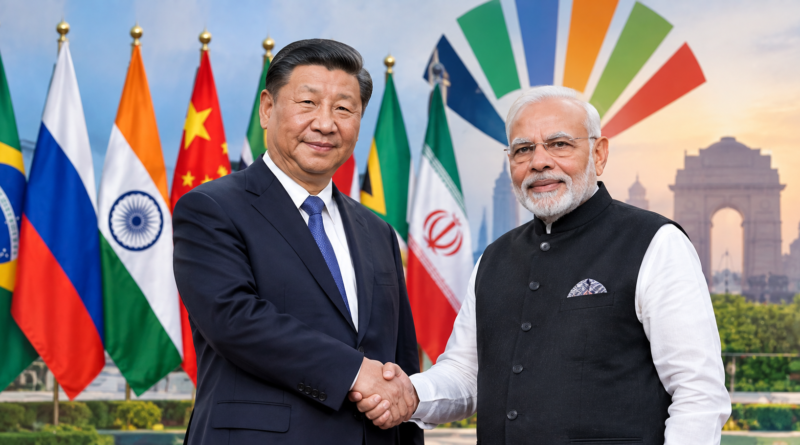
Xi Jinping BRICS Summit 2026: China President Arrives in Delhi After 7 Years, Meets PM Modi
Xi Jinping BRICS Summit 2026: Chinese President Xi Jinping arrived in New Delhi on Saturday for the 18th BRICS Summit, marking his first visit to India in seven years. His arrival has drawn significant attention as India and China attempt to stabilise bilateral relations while the BRICS grouping faces major geopolitical and economic challenges.
The summit is being held in New Delhi on September 12 and 13, bringing together leaders from major emerging economies. Xi’s visit is particularly significant because it comes after years of tensions between India and China, including the 2020 border clash.
Xi Jinping Arrives in Delhi for BRICS Summit
Xi Jinping reached New Delhi on Saturday to attend the 18th BRICS Summit at the invitation of Prime Minister Narendra Modi. China’s Foreign Ministry had earlier confirmed that Xi would participate in the summit from September 12 to 13.
His visit is the Chinese president’s first trip to India since 2019. The return to New Delhi is being closely watched because relations between the two Asian powers have remained complicated since the deadly 2020 border confrontation in Ladakh.
Xi’s presence also comes at a time when BRICS is seeking a greater role in global economic and political affairs.
Xi Jinping Says BRICS Has ‘Enormous Potential’
During his participation in the summit, Xi Jinping highlighted BRICS as an important platform for emerging markets and developing countries.
China has consistently promoted BRICS as a forum for greater cooperation among developing economies, with an emphasis on economic development, multilateralism and reform of global institutions. Chinese officials have described the grouping as an increasingly important platform for the Global South.
Xi has also called for greater fairness and justice in international affairs, while emphasising the potential of BRICS to strengthen cooperation among its members.
Xi Jinping Meets PM Modi in Delhi
One of the most closely watched events of the Xi Jinping BRICS Summit was the bilateral meeting between Xi and Prime Minister Narendra Modi.
The two leaders met on the sidelines of the summit on Saturday. Their meeting lasted more than 50 minutes and focused on strengthening long-term India-China relations and exploring areas of cooperation.
Xi stressed the importance of viewing China-India relations from a long-term and strategic perspective. Modi, meanwhile, highlighted the opportunity to discuss areas where the two countries can cooperate.
The meeting is significant because both countries have been attempting to improve ties while continuing to deal with unresolved strategic and security differences.
Why Xi Jinping’s India Visit Matters
Xi’s visit carries importance beyond the BRICS Summit itself.
India and China are two of the world’s largest economies and major powers in Asia. Both countries are also members of several multilateral organisations, making their ability to cooperate important for the wider Global South.
The two sides have recently taken steps aimed at reducing tensions and improving diplomatic engagement. However, significant disagreements remain, particularly over the border, trade and China’s broader strategic role in South Asia.
The latest meeting therefore represents a cautious attempt to build a more stable relationship rather than an indication that all differences have been resolved.
BRICS Summit Takes Place Amid Middle East War
The 2026 BRICS Summit is taking place against the backdrop of continuing conflict in the Middle East and the war in Ukraine.
Xi Jinping called for BRICS countries to play a greater role in promoting peace in the Middle East. He argued that the ongoing conflict does not serve the common interests of the international community.
The issue presents a complicated challenge for BRICS because the expanded grouping includes countries with very different geopolitical relationships and interests.
Iran is now part of the expanded BRICS grouping, while India, China, Russia and the Gulf members have their own strategic and economic interests in the region.
BRICS Has Become Much Larger
BRICS has expanded considerably from its original five-member structure.
The grouping initially consisted of Brazil, Russia, India, China and South Africa. It has since expanded to include countries such as Egypt, Ethiopia, Indonesia, Iran, Saudi Arabia and the United Arab Emirates.
The expanded bloc now represents a substantial share of the world’s population and global economic output.
According to recent estimates cited ahead of the summit, BRICS members account for about half of the world’s population and roughly 40% of global GDP on a purchasing-power-parity basis.
This expansion has strengthened the group’s economic weight but has also made reaching consensus more difficult.
Xi Pushes for Greater Role for Emerging Economies
China has long advocated greater representation for developing and emerging economies in global institutions.
At BRICS meetings, Beijing has repeatedly called for reforms to institutions such as the International Monetary Fund and World Bank, arguing that emerging markets and developing countries remain underrepresented in global decision-making structures.
Xi’s BRICS agenda has also included cooperation in areas such as:
- Digital economy
- Artificial intelligence
- Green industries
- Clean energy
- Financial cooperation
- Global economic governance
- Trade and investment
- Development cooperation
China has positioned BRICS as a mechanism through which developing countries can gain a stronger voice in international affairs.
Heavy Security in Delhi During Xi’s Visit
Xi Jinping’s short visit has also resulted in an extensive security operation across New Delhi.
Reports said around 15,000 security personnel, including Delhi Police and paramilitary forces, were deployed for the high-profile summit and the movement of visiting leaders.
Xi’s visit is expected to last around 24 hours, with security agencies coordinating his movements alongside those of other visiting leaders.
The summit has brought several high-profile leaders to the capital, increasing the security requirements around hotels, roads, venues and airports.
Separate Arrangements for Major Leaders
The security operation has involved detailed planning because multiple high-profile leaders are attending the summit.
Russian President Vladimir Putin and Iranian President Masoud Pezeshkian are among the other major leaders attending the New Delhi gathering. The presence of leaders from countries involved in major geopolitical disputes has required extensive coordination by Indian security agencies.
The summit therefore represents not only a major diplomatic event but also one of the largest international security operations in Delhi this year.
What Does Xi’s Visit Mean for India-China Relations?
The biggest question surrounding the Xi Jinping BRICS Summit is whether the visit can accelerate the India-China diplomatic reset.
Relations between the two countries have improved somewhat after years of heightened tensions, but trust remains limited.
Both governments have an interest in maintaining stable relations. India wants to protect its economic and strategic interests while continuing its policy of strategic autonomy. China, meanwhile, wants stronger ties with India and greater cooperation within BRICS.
However, the border dispute, trade imbalance, Chinese investments and wider strategic competition remain difficult issues.
The meeting between Modi and Xi is therefore best viewed as another step in diplomatic engagement rather than a complete reset of bilateral relations.
China to Chair BRICS in 2027
Another important development at the summit is China’s upcoming leadership of BRICS.
China is scheduled to take over the BRICS chairmanship in 2027 and host the group’s next summit. This will give Beijing another opportunity to influence the bloc’s agenda and priorities.
China is likely to continue pushing for greater economic cooperation among emerging economies, reforms to international institutions and a stronger role for the Global South.
What to Watch After the BRICS Summit
The outcome of the summit could have implications beyond the two-day meeting.
Key areas to watch include:
India-China relations: Whether the Modi-Xi meeting results in additional diplomatic or economic engagement.
BRICS cooperation: Whether members can agree on practical initiatives despite their differing geopolitical interests.
Middle East conflict: Whether BRICS can play a meaningful role in encouraging de-escalation.
Trade and finance: Whether members make progress on local-currency trade and alternative payment mechanisms.
Global governance: Whether the group can build support for reforms to institutions such as the IMF and World Bank.
China’s 2027 BRICS presidency: The direction Beijing takes when it assumes leadership of the grouping next year.
Bottom Line
The Xi Jinping BRICS Summit 2026 has become an important diplomatic moment for both India-China relations and the wider Global South.
Xi Jinping’s first visit to India in seven years, his meeting with Narendra Modi and China’s upcoming BRICS chairmanship in 2027 have given the New Delhi summit additional significance.
At the same time, the summit is taking place amid wars, trade tensions and growing competition between major powers. Xi is seeking a stronger role for BRICS in global governance and has urged the bloc to contribute to peace efforts, particularly in the Middle East.
For India, the challenge will be to use BRICS as a platform for cooperation while maintaining its strategic autonomy and managing its complex relationship with China. The Modi-Xi meeting suggests that dialogue is continuing, but major differences between the two countries remain unresolved.