
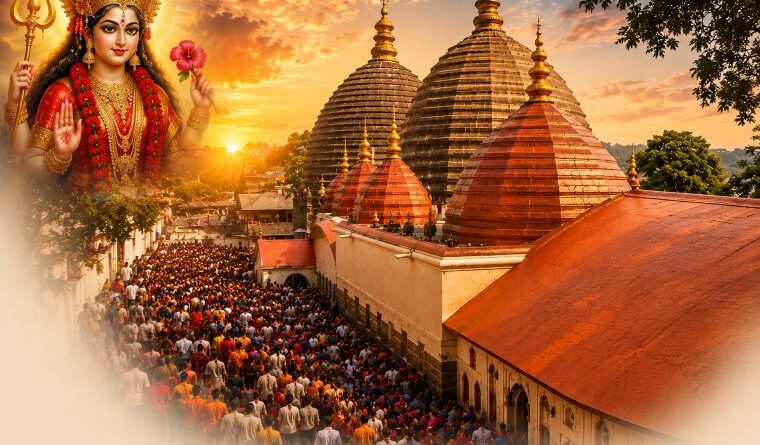
Ambubachi Mela 2026 Begins at Kamakhya Temple, Lakhs of Devotees Gather for Sacred Festival
One of India’s most revered spiritual gatherings, the annual Ambubachi Mela, has commenced at the historic Kamakhya Temple in Assam, drawing lakhs of devotees, saints, sadhus, and tantric practitioners from across the country and abroad. Authorities expect more than eight lakh pilgrims to participate in the four-day festival, making it one of the largest religious congregations in Eastern India.
The festival officially began on June 22 with the sacred Pravritti ritual, after which the temple’s sanctum sanctorum was closed to devotees. According to tradition, the closure symbolizes the annual menstruation cycle of Goddess Kamakhya, representing fertility, creation, and the divine feminine power. The temple will remain closed for three days before reopening with the Nivritti rituals on June 26.
A Festival Rooted in Shakti and Tantra Traditions
Ambubachi Mela holds immense significance in Shakta and Tantric traditions. Unlike most religious festivals, it celebrates the creative and regenerative forces of nature through the symbolic menstruation of the goddess. During this period, devotees believe that Goddess Kamakhya enters a state of rest, and worship inside the sanctum is temporarily suspended.
The festival attracts a unique gathering of spiritual seekers, including ascetics, aghoris, tantrics, and pilgrims who travel long distances to receive blessings and participate in rituals associated with divine feminine energy.
Massive Preparations for Pilgrim Influx
The Assam government and temple authorities have implemented extensive arrangements to manage the expected crowds. Special camps, medical facilities, drinking water stations, food distribution centers, and security measures have been established to ensure a smooth experience for visitors. Multiple accommodation camps have also been set up for pilgrims arriving from different parts of India.
Assam Tourism Minister Ajanta Neog inaugurated the event and called upon all stakeholders to cooperate in ensuring the successful conduct of the mela. Officials have emphasized crowd management, sanitation, healthcare services, and transportation facilities throughout the festival period.
Economic Boost for Local Communities
Beyond its spiritual significance, Ambubachi Mela serves as a major economic driver for local businesses and traders. Vendors selling religious items, food, handicrafts, and other goods rely heavily on the influx of pilgrims during the festival. For many families, the annual mela represents a crucial source of income and livelihood.
Hotels, transport operators, local markets, and small businesses across Guwahati also experience increased activity during the event, contributing significantly to the regional economy.
Temple Doors to Reopen on June 26
Following the completion of the sacred observance period, the temple will reopen on June 26 after purification ceremonies. Devotees will then be allowed to offer prayers and receive the revered prasad associated with the festival. Traditionally, sacred offerings such as Angodak and Angabastra are distributed to pilgrims after the reopening rituals.
As lakhs of devotees continue to arrive at Nilachal Hill, Ambubachi Mela 2026 once again highlights the enduring spiritual, cultural, and historical significance of the Kamakhya Temple, reinforcing its status as one of India’s most important centers of faith and tantric worship.
FAQs About Ambubachi Mela 2026
1. What is Ambubachi Mela?
Ambubachi Mela is an annual religious festival held at the Kamakhya Temple in Assam. It celebrates the divine feminine and is associated with the belief that Goddess Kamakhya undergoes her annual menstrual cycle during this period.
2. Why does Kamakhya Temple close during Ambubachi Mela?
The temple remains closed for three days because devotees believe Goddess Kamakhya enters a period of menstruation and rest. During this time, regular worship inside the sanctum sanctorum is suspended.
3. When did Ambubachi Mela 2026 begin?
Ambubachi Mela 2026 began on June 22 with the sacred Pravritti ritual, marking the start of the festival and the closure of the temple sanctum.
4. When will Kamakhya Temple reopen in 2026?
The temple is scheduled to reopen on June 26 after the completion of the Nivritti rituals and purification ceremonies.
5. Where is Kamakhya Temple located?
Kamakhya Temple is situated on Nilachal Hill in Guwahati, Assam. It is one of the most important Shakti Peethas in India.
6. Why is Ambubachi Mela important in Hinduism?
The festival holds special significance in Shakta and Tantric traditions as it symbolizes fertility, creation, and the regenerative power of nature through the worship of the divine feminine.
7. How many devotees attend Ambubachi Mela?
More than eight lakh devotees are expected to participate in Ambubachi Mela 2026, making it one of the largest religious gatherings in Eastern India.
8. Who attends Ambubachi Mela?
The festival attracts devotees, saints, sadhus, aghoris, tantric practitioners, spiritual seekers, and pilgrims from across India and abroad.
9. What special arrangements have been made for pilgrims?
Authorities have set up medical camps, drinking water facilities, food distribution centers, accommodation camps, sanitation services, transportation support, and enhanced security measures.
10. What are Angodak and Angabastra?
Angodak (sacred water) and Angabastra (sacred cloth) are revered offerings distributed to devotees after the temple reopens. They are considered highly auspicious and are associated with the blessings of Goddess Kamakhya.
11. What is the significance of Kamakhya Temple?
Kamakhya Temple is one of the 51 Shakti Peethas and is regarded as one of the most important centers of Shakti worship and Tantra traditions in India.
12. How does Ambubachi Mela impact the local economy?
The festival boosts tourism and generates income for hotels, transport operators, local traders, artisans, food vendors, and small businesses throughout Guwahati and surrounding areas.