
Dyson CameraJet Toothbrush Launched at $499: The Camera-Powered Brush That Also Flosses
Dyson has entered the oral-care market with one of its most unusual products yet: the Dyson CameraJet, a high-tech toothbrush that combines brushing with targeted flossing using a built-in camera and powerful jets of mouthwash.
Priced at $499, the CameraJet is designed to identify gaps between teeth in real time and direct a burst of liquid into those spaces to help remove plaque and debris. The product is the result of approximately six years of development and represents Dyson’s first major move into the oral-care category.
What Is the Dyson CameraJet?
The Dyson CameraJet is not simply an electric toothbrush with a camera attached.
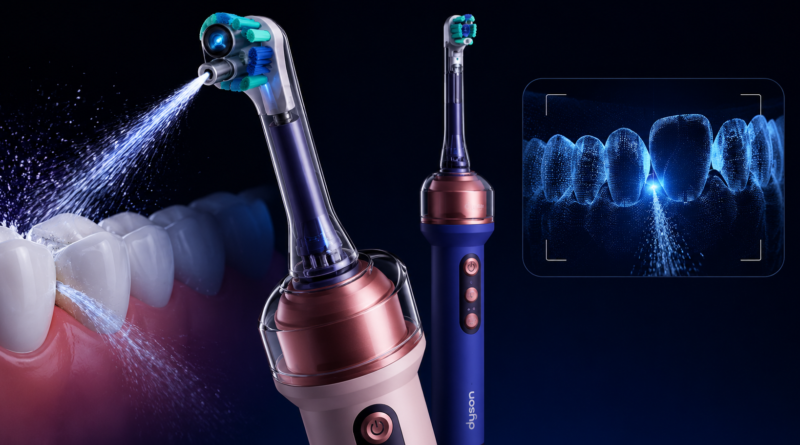
Its main selling point is the combination of AI-powered visual analysis, brushing and targeted liquid jets. A tiny camera built into the brush head captures 28 images per second, allowing the system to identify spaces between teeth as the brush moves around the mouth.
When the system detects a gap, it can trigger a concentrated burst of mouthrinse designed to reach between the teeth.
This essentially combines two traditionally separate parts of an oral-care routine: brushing and flossing.
How Does the CameraJet Work?
The technology behind the CameraJet is built around three main components:
- A conventional-style brush system for cleaning tooth surfaces
- A miniature camera for analysing the mouth
- A liquid-jet system designed to target spaces between teeth
The camera continuously monitors the teeth while the brush is being used. According to Dyson, the system processes 28 live images every second to detect gaps that need additional attention.
Once a gap is identified, a conical stream of mouthrinse is directed toward it.
The goal is to provide more targeted cleaning than a conventional toothbrush can offer on its own.
A Toothbrush That Also Flosses
The biggest difference between the CameraJet and ordinary electric toothbrushes is its attempt to automate interdental cleaning.
Many people brush regularly but do not floss consistently. Dyson’s approach is to incorporate this additional step directly into the brushing process.
Instead of manually moving dental floss between individual teeth, the CameraJet uses its camera to locate spaces and then uses liquid pressure to target them.
Dyson describes the product as a toothbrush that can effectively brush and floss at the same time.
Dyson CameraJet Price
The Dyson CameraJet has been launched at $499, putting it firmly into the premium segment of the electric-toothbrush market.
The company is also introducing a special non-foaming Dyson toothpaste designed to be used with the system.
The toothbrush will initially be offered in pink and blue colour options.
It is expected to become available through major retailers including Sephora, Best Buy and Amazon during September 2026, with Costco availability planned later in the fall.
Why Does the Camera Matter?
The camera is arguably the most unusual component of the CameraJet.
Traditional electric toothbrushes generally rely on vibration or oscillation to clean teeth, with the user responsible for deciding where to spend more time.
Dyson’s approach attempts to make the toothbrush more aware of what’s happening inside the user’s mouth.
By continuously analysing the spaces between teeth, the CameraJet can determine where its liquid jet needs to be directed.
That makes the device closer to a smart oral-care system than a conventional electric toothbrush.
Dyson Spent Six Years Developing It
The CameraJet wasn’t developed overnight.
Dyson engineers reportedly spent around six years working on the product, with the company having to solve a completely different engineering problem from its traditional air-based technologies.
Dyson is famous for products involving airflow, suction and high-speed motors. The CameraJet required the company to develop a sophisticated system for controlling liquid.
The engineers created a pump mechanism and a gravity-free tank, allowing the liquid system to work regardless of the angle at which the toothbrush is held.
James Dyson’s Personal Motivation
Dyson founder James Dyson has acknowledged that his own experiences with dental hygiene helped inspire the project.
Despite describing himself as someone who flosses regularly, Dyson said dental visits often revealed plaque that had still accumulated between his teeth.
That frustration reportedly helped motivate the development of a device that could provide more effective cleaning between teeth without requiring traditional flossing.
The CameraJet therefore fits into Dyson’s familiar approach: identify a common problem and attempt to engineer a new solution.
Why Is Dyson Entering Oral Care?
The move represents a significant expansion for Dyson.
The company is best known for vacuum cleaners, hair dryers, air purifiers and other household technology. It has also previously entered personal-care categories with products such as the Supersonic hair dryer and Airwrap.
The CameraJet extends that strategy into dental care.
Rather than competing purely on motor power or brushing modes, Dyson is attempting to differentiate itself through engineering, imaging and automation.
A $499 Toothbrush in a Crowded Market
The biggest challenge for Dyson could be convincing consumers that the technology justifies the price.
At $499, the CameraJet costs considerably more than many premium electric toothbrushes.
The oral-care market is already dominated by established brands offering smart sensors, pressure detection, multiple cleaning modes and app connectivity.
Dyson is therefore betting that consumers will be willing to pay significantly more for a device that combines brushing with automated interdental cleaning.
Dyson’s Unusual Approach to Business
The CameraJet also reflects James Dyson’s distinctive approach to product development.
Dyson has previously pursued ambitious products that eventually succeeded, while also abandoning projects that failed to make commercial sense.
The company famously cancelled its electric-car project in 2019 after determining that it would not be commercially viable.
Dyson has indicated that the CameraJet will ultimately have to prove itself in the market, suggesting that the company is willing to discontinue the product if consumers do not embrace it.
Dyson CameraJet: Key Specifications
| Feature | Details |
| Product | Dyson CameraJet |
| Category | Smart electric toothbrush |
| Price | $499 |
| Camera | Built into brush head |
| Image processing | 28 images per second |
| Main function | Brushing + targeted interdental cleaning |
| Liquid system | Targeted mouthrinse jets |
| Tank technology | Gravity-free design |
| Toothpaste | Special non-foaming Dyson toothpaste |
| Colours | Pink and Blue |
| Launch | September 2026 |
| Brand | Dyson |
Is the Dyson CameraJet Worth $499?
That will ultimately depend on how effectively the technology performs in everyday use.
The concept is certainly different. Instead of asking users to remember to brush and floss separately, Dyson is attempting to integrate both tasks into a single automated routine.
The camera-driven targeting system is also an unusual addition that could make the product particularly interesting for technology enthusiasts.
However, $499 is a significant investment for a toothbrush, and consumers will likely expect measurable improvements in cleaning performance to justify the premium.
Dyson’s Next Big Experiment
The CameraJet is another example of Dyson trying to rethink an ordinary household product through engineering.
The company took a familiar object — the toothbrush — and added a camera, image analysis, liquid jets and a specialised pump system.
Whether consumers consider that a revolutionary improvement or an unnecessarily complicated solution remains to be seen.
But one thing is clear: Dyson’s $499 CameraJet is bringing cameras and targeted jets into a product category that has remained largely unchanged for decades.
If Dyson’s technology delivers on its promise, the CameraJet could mark the beginning of a new generation of smart oral-care products.