
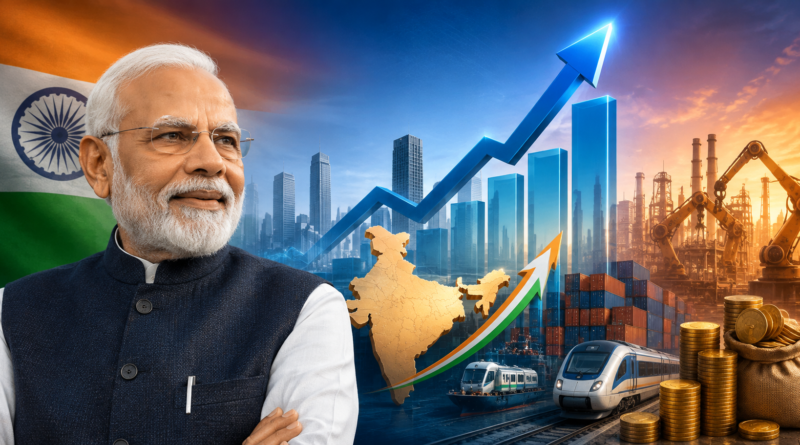
India Records 7.8% GDP Growth: PM Modi Hails Strong Numbers and Calls for Swadeshi Push
“7.8% growth. Strong numbers. Even stronger confidence.” PM Modi highlighted India’s latest economic performance as the country recorded 7.8% real GDP growth in the April-June quarter of FY2026-27.
The stronger-than-expected growth has prompted the Prime Minister to praise the resilience of India’s economy while urging citizens to support domestic products, local tourism and businesses.
India Posts 7.8% GDP Growth in Q1 FY27
India’s economy expanded by 7.8% year-on-year during the first quarter of FY27, outperforming both market expectations and the Reserve Bank of India’s earlier estimate of 7%.
The latest figure also reflects strong momentum across important parts of the economy, including manufacturing, financial services, investment and domestic consumption. Manufacturing grew by 9.2%, while financial, real-estate, IT and professional services recorded strong expansion.
The growth rate was slightly below the revised 8.6% expansion recorded in the previous quarter, but it still represented a stronger performance than economists had anticipated.
PM Modi Calls Growth a Sign of Stronger Confidence
Reacting to the latest GDP figures, Prime Minister Modi shared a short video message celebrating the country’s economic performance.
His message was summed up in three lines:
“7.8% growth.
Strong numbers.
Even stronger confidence.”
The Prime Minister described the growth as evidence of India’s collective strength and resilience, particularly at a time when the global economy continues to face geopolitical tensions, supply-chain disruptions and energy-related uncertainty.
PM Modi Revives the Swadeshi Message
Alongside celebrating the GDP numbers, Modi used the occasion to make another appeal for Swadeshi and self-reliance.
He encouraged Indians to spend more within the country and support Indian products and services.
The Prime Minister specifically urged people to reconsider unnecessary spending overseas, including foreign leisure trips and weddings held abroad.
He also advised citizens to avoid purchasing gold unless it was necessary.
The broader message was that more domestic spending could help strengthen India’s internal economy and support local businesses.
“Don’t Buy Gold Unless Necessary”
One of the most talked-about parts of Modi’s message was his appeal regarding gold purchases.
The Prime Minister said that people should not buy gold unless it is necessary.
The appeal forms part of his broader economic argument around reducing unnecessary imports and encouraging spending that contributes more directly to domestic economic activity.
The comments also attracted attention in the jewellery sector, with reports noting movement in jewellery stocks following the remarks.
Why Does Gold Matter to India’s Economy?
Gold has a deep cultural and financial significance in India, but the country also imports a large quantity of the precious metal.
Reducing unnecessary gold purchases can potentially help limit import demand and the associated pressure on the country’s external accounts.
Modi’s latest comments therefore connect an everyday consumer decision with a larger economic objective: encouraging Indians to prioritise domestic consumption and investment.
A Push Against Foreign Spending
Gold was not the only area mentioned by the Prime Minister.
Modi also asked citizens to avoid foreign leisure travel when it is not necessary and encouraged Indians to choose destinations within the country.
He similarly appealed to families to consider holding weddings in India rather than spending large amounts on overseas destination weddings.
The idea is to keep more consumer spending within India, supporting domestic tourism, hospitality, transportation, retail and other service industries.
The “Swadeshi” Idea Behind the Message
Modi’s latest comments revive a familiar Swadeshi theme — encouraging people to favour Indian products and businesses.
The Prime Minister linked greater emphasis on domestic products and services with the long-term goal of making India more self-reliant.
He also connected the effort with India’s ambition to become a developed country and said today’s economic decisions could help create greater opportunities for the country’s younger generation.
Growth Comes Despite Global Challenges
The 7.8% GDP expansion comes against a difficult international backdrop.
Global energy prices, geopolitical tensions, supply-chain disruptions and uncertainty in financial markets continue to pose challenges for economies around the world.
India has also faced concerns related to rising crude oil prices because of its dependence on imported energy.
Despite these challenges, strong domestic demand, manufacturing activity and investment helped support India’s growth during the April-June quarter.
What Drove India’s 7.8% Growth?
Several sectors contributed to the latest economic performance.
Manufacturing
Manufacturing expanded by 9.2%, making it one of the important contributors to the quarter’s growth.
Financial and Professional Services
Financial, real-estate, IT and professional services recorded strong growth, with the broader sector expanding by around 12.1%.
Private Investment
Private investment also strengthened significantly, with investment growth accelerating during the quarter.
Domestic Consumption
Resilient consumer spending provided another important source of momentum for the economy.
Can India Maintain This Growth Rate?
The latest numbers are encouraging, but maintaining growth at this level will remain a challenge.
Economists have pointed to risks including high crude oil prices, inflation, global interest rates, geopolitical tensions and weather-related uncertainties.
India’s Chief Economic Adviser V. Anantha Nageswaran has described near-term domestic momentum as strong while warning that global uncertainties could eventually affect economic activity.
The Reserve Bank of India has maintained a more cautious full-year growth outlook, highlighting the risks that could emerge during the remainder of FY27.
7.8% GDP Growth: Key Numbers
| Indicator | Latest Figure |
| Q1 FY27 GDP growth | 7.8% |
| Quarter | April–June 2026 |
| Previous quarter’s revised growth | 8.6% |
| Manufacturing growth | 9.2% |
| RBI’s earlier Q1 estimate | 7.0% |
| Market growth forecast | Around 7.1% |
| Financial/professional services growth | Around 12.1% |
PM Modi’s Message: Growth With Greater Self-Reliance
The latest GDP figures have given the government an opportunity to highlight India’s economic resilience.
But Modi’s message was about more than celebrating the numbers. He also called on citizens to contribute to the country’s economic strength through their everyday choices — from buying Indian products to spending on domestic tourism and avoiding unnecessary gold purchases.
His broader argument is that economic growth is not only driven by government policies and businesses but also by consumer behaviour.
Strong Numbers, But the Road Ahead Matters
India’s 7.8% GDP growth in Q1 FY27 is undoubtedly a strong economic performance, especially against a backdrop of global uncertainty.
However, the bigger challenge will be sustaining that momentum throughout the financial year.
For now, the latest numbers have strengthened confidence in India’s domestic economy and given the government fresh momentum behind its Swadeshi and self-reliance message.
As PM Modi put it: “7.8% growth. Strong numbers. Even stronger confidence.”