
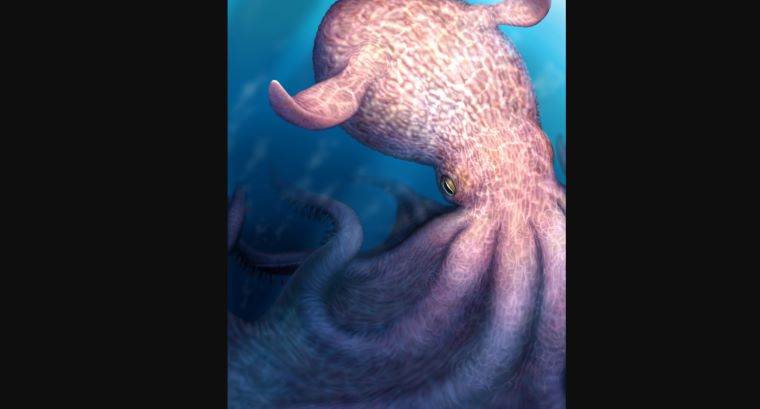
Giant Octopus Fossil Discovery: Did a Real-Life “Kraken” Rule the Oceans 100 Million Years Ago?
A groundbreaking scientific discovery has stunned researchers and sparked global curiosity: fossil evidence suggests that giant octopus-like creatures—similar to the mythical Kraken—once ruled Earth’s oceans during the age of dinosaurs.
This finding is not just fascinating—it could rewrite what we know about prehistoric marine life and ocean predators.
What Did Scientists Discover?
Researchers have uncovered fossilized remains—specifically beaks (jaw structures)—of enormous octopus-like creatures that lived around 100 million years ago during the Late Cretaceous period.
- Estimated size: up to 60–62 feet (18–19 meters)
- Species identified: Nanaimoteuthis haggarti and related species
- Among the largest invertebrates ever discovered
These creatures were comparable in size to a school bus and even rivaled some marine reptiles in length.
A Real-Life “Kraken”?
The discovery has drawn comparisons to the legendary Kraken, a giant sea monster from Norse mythology said to drag ships into the ocean.
Scientists now believe:
These myths may have been inspired by real ancient creatures.
- Fossil evidence shows these octopuses were powerful predators
- They had strong beaks capable of crushing bones and shells
- Their size and behavior match descriptions of mythical sea monsters
Not Sharks or Reptiles — But Octopuses?
Until now, scientists believed that marine reptiles like mosasaurs and giant sharks dominated ancient oceans.
But this discovery challenges that idea.
- These giant octopuses were likely apex predators
- They competed with—and possibly preyed on—other large marine animals
- They occupied the top of the food chain, not the bottom
This is a major shift in understanding prehistoric ecosystems.
Intelligent Hunters of the Ancient Seas
Modern octopuses are known for their intelligence—and their ancient ancestors may have been just as impressive.
Fossil analysis revealed:
- Wear patterns on beaks, showing repeated crushing of hard prey
- Evidence of “handedness” (preference for one side), indicating advanced behavior
- Ability to hunt complex prey like crustaceans and fish
👉 This suggests these creatures were not just big—but highly intelligent predators.
How Did Scientists Find Them?
Octopuses rarely fossilize because their bodies are mostly soft tissue. That’s why this discovery is so important.
Scientists used a technique called digital fossil reconstruction, where they:
- Sliced open ancient rock formations
- Scanned fossil fragments
- Reconstructed 3D models of the creatures
This helped identify hidden jaw fossils inside rocks, revealing their size and structure for the first time
Why This Discovery Matters
This discovery changes several long-held beliefs:
1. Octopuses Were Not Minor Creatures
They were actually top predators, not just small marine animals.
2. Ocean Ecosystems Were More Complex
The food chain included intelligent invertebrates competing with vertebrates.
3. Myths May Have Scientific Roots
Stories of giant sea monsters like the Kraken may not be entirely fictional.
What Happened to These Giant Creatures?
Scientists believe these massive octopuses:
- Lived between 100–72 million years ago
- Likely went extinct around the same time as dinosaurs
- Disappeared due to environmental changes or evolutionary shifts
However, due to limited fossils, their exact extinction cause remains unknown.
A New Chapter in Ocean History
This discovery opens the door to a new understanding of Earth’s past.
It suggests that:
- The oceans were home to unexpected giants
- Evolution produced advanced predators in surprising forms
- There may still be undiscovered species hidden in the fossil record
Conclusion
The discovery of a giant octopus fossil has blurred the line between science and myth.
👉 What was once considered a legend—the Kraken—may have had a real counterpart in Earth’s ancient oceans.
With creatures reaching 60 feet long and dominating the seas, it’s clear that prehistoric oceans were far more mysterious—and terrifying—than we ever imagined.