
Why Mumbai’s Famous Buddhi Ke Baal Has Turned White — And the FDA Officer Behind the Crackdown
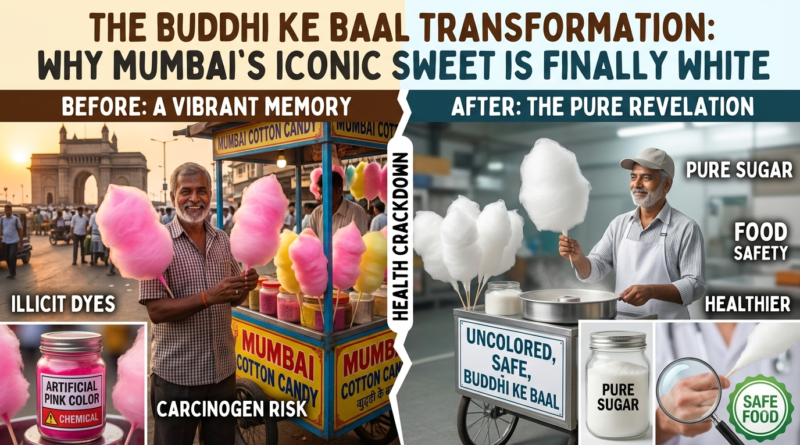
Mumbai’s iconic pink buddhi ke baal has suddenly started looking very different.
The familiar bright pink cotton candy that has been a part of Mumbai’s street-food culture for years is now appearing plain white at several stalls. And this time, the change isn’t a new food trend.
It is connected to Maharashtra’s ongoing crackdown on the use of unauthorised and questionable food colours.
At the centre of this wider food-safety drive is Tukaram Mundhe, Commissioner of Maharashtra’s Food and Drug Administration (FDA) and Food Safety Commissioner. His strict approach toward food-safety violations has brought renewed attention to what goes into some of the brightly coloured foods sold across the state.
Why Has Buddhi Ke Baal Turned White?
The answer is actually quite simple: without added colouring, cotton candy is naturally white.
The traditional treat is made by spinning sugar into thin strands. The bright pink, blue and other colours seen at many street stalls come from added food colouring.
As food-safety inspections have intensified, some vendors have stopped using bright colours, resulting in cotton candy that looks much closer to its natural appearance.
For many Mumbai residents, seeing white buddhi ke baal has therefore come as a surprise.
The change has also sparked a wave of social-media reactions, with people sharing pictures and videos of the colourless candy and joking that the “original” buddhi ke baal is back.
Who Is Tukaram Mundhe?
Tukaram Mundhe is an IAS officer who took charge as Maharashtra’s FDA Commissioner in May 2026.
Since then, he has become one of the most talked-about bureaucrats in Maharashtra because of his aggressive approach to food-safety enforcement.
His reputation is built around surprise inspections, strict action and little tolerance for businesses that violate food-safety rules. The Indian Express reported that the FDA conducted 1,131 inspections across Maharashtra in the first weeks of his tenure and suspended the licences of dozens of restaurants.
Mundhe has repeatedly emphasised that the purpose of the campaign is not to target businesses simply for the sake of enforcement, but to protect consumers.
In an interview with India Today, he described the objective simply as “safe food, safe drugs, safe Maharashtra.”
His Message to Food Businesses Is Clear
Mundhe has taken a particularly firm position against businesses that put public health at risk.
In a recent interview, he said that no food business operator violating the law would be spared, while also acknowledging that the FDA has manpower limitations and therefore has to prioritise inspections.
The department’s work isn’t limited to cotton candy.
Its wider campaign has involved inspections of restaurants, street-food establishments and other food businesses, along with action against adulteration and unsafe food practices.
The FDA has also taken action involving synthetic food colours in sweets. For example, authorities reported the use of Tartrazine in imarti and jalebi at one establishment during an inspection.
The “Pink Food” We Are Used To Seeing
For years, bright colours have been closely associated with Indian street food.
Pink buddhi ke baal, orange jalebi, intensely red gravies and brightly coloured Chinese dishes are visually attractive and can make food look more appetising.
But Mundhe’s campaign has encouraged businesses to reconsider whether that colour is actually necessary.
And consumers are beginning to notice.
Some restaurants and street-food vendors have reportedly reduced or stopped using artificial colours, meaning foods that once looked extremely bright are now appearing more natural.
The change may look unusual at first—but that’s exactly what has made the issue so visible.
Is White Cotton Candy Better?
The white colour itself doesn’t automatically make cotton candy healthier.
What matters is what ingredients are being used, whether permitted food colours are involved, and whether the food is prepared and handled safely.
The important point is that a food product does not need an unnaturally bright colour to be safe or tasty.
The FDA’s role is to enforce food-safety standards and prevent the sale of adulterated, misbranded, substandard or banned food products.
Why This Crackdown Matters
The buddhi ke baal story may look funny on social media, but there is a serious message behind it.
A small change in the colour of cotton candy has made people ask a bigger question:
Why was our food so colourful in the first place?
The FDA’s campaign under Tukaram Mundhe has brought food safety back into everyday conversations—from cotton candy and jalebi to restaurant food and street snacks.
And perhaps the biggest change is that consumers are now looking beyond appearance.
That bright red, pink or orange colour may make food look attractive, but what matters more is what is actually being added to it.
From Pink to White: A Small Change That Started a Big Conversation
Mumbai’s white buddhi ke baal has become more than just a viral social-media moment.
It is a visible result of a much larger conversation about food colours, adulteration and public health.
For vendors, it may mean changing familiar recipes and presentation.
For consumers, it may mean getting used to food that looks a little less colourful.
And for Maharashtra’s FDA Commissioner Tukaram Mundhe, the message remains straightforward: food businesses are expected to follow the rules, and public health comes first.
So the next time you see white buddhi ke baal instead of the familiar pink version, you may not be looking at a new trend at all.
You could be looking at one small, visible sign of Maharashtra’s much bigger food-safety crackdown.