
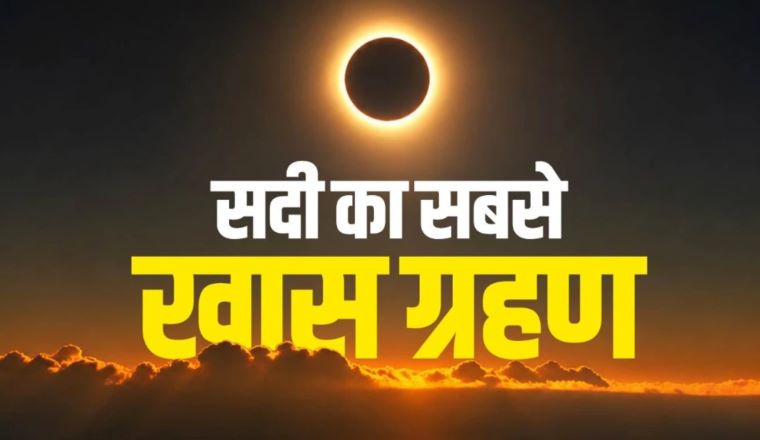
Surya Grahan 2026: August Solar Eclipse Date, Time, Ring of Fire Effect and Visibility Details
The year 2026 is set to become a remarkable year for skywatchers and astronomy enthusiasts across the globe. One of the most anticipated celestial events is the August 2026 Solar Eclipse. Reports circulating worldwide suggest that this eclipse will be among the most significant astronomical events of the decade, drawing the attention of scientists, photographers, and eclipse chasers alike. According to astronomical predictions, a major solar eclipse (surya grahan) will occur on 12 August 2026, creating spectacular views across several regions of the world.
Many media reports have described the event as a “Ring of Fire” eclipse, while scientific sources classify the August 12, 2026 event as a total solar eclipse visible along a specific path crossing Greenland, Iceland, Spain, parts of Russia, and surrounding regions. Other locations will witness a partial eclipse.
What is a Solar Eclipse?
A solar eclipse occurs when the Moon passes between the Earth and the Sun, blocking sunlight either partially or completely. Depending on the alignment and distance of the Moon from Earth, eclipses can be classified into:
- Total Solar Eclipse
- Annular Solar Eclipse (Ring of Fire)
- Partial Solar Eclipse
- Hybrid Solar Eclipse
During a total solar eclipse, the Moon completely covers the Sun, allowing observers to see the Sun’s outer atmosphere, known as the corona.
August 2026 Solar Eclipse Date and Time
The solar eclipse is expected to occur on 12 August 2026. Astronomical calculations indicate that the eclipse will begin in the afternoon UTC and reach its greatest eclipse around 17:47 UTC. Exact timings will vary depending on geographic location.
Key Eclipse Details
| Event | Date |
| Solar Eclipse Date | 12 August 2026 |
| Eclipse Type | Total Solar Eclipse |
| Greatest Eclipse | Around 17:47 UTC |
| Visible Regions | Greenland, Iceland, Spain, Russia, Atlantic regions |
| Partial Visibility | Parts of Europe, Africa, North America |
Why is the August 2026 Eclipse Special?
Astronomers consider 2026 the beginning of a remarkable series of solar eclipses occurring between 2026 and 2028. During this period, the world will witness multiple total and annular eclipses, making it a golden era for eclipse observation.
The August 2026 eclipse is especially significant because:
- It will be the first major total solar eclipse visible from mainland Europe in decades.
- Millions of people will have access to excellent viewing opportunities.
- Some regions will witness the eclipse near sunset, creating dramatic photography conditions.
- It serves as a precursor to the famous “Eclipse of the Century” expected in August 2027.
Will the Solar Eclipse Be Visible in India?
Current astronomical projections indicate that the path of totality will not pass through India. Therefore, the eclipse will either not be visible or will have very limited visibility from many parts of the country. Local visibility depends on geographical location and official eclipse calculations released closer to the event date.
Ring of Fire Effect Explained
The phrase “Ring of Fire” refers to an annular solar eclipse where the Moon appears slightly smaller than the Sun and leaves a bright ring of sunlight visible around its edges.
Although several reports connect the August 2026 eclipse with the Ring of Fire phenomenon, scientific eclipse databases identify the August 12 event primarily as a total solar eclipse. However, 2026 as a whole includes notable annular eclipse events that contribute to public interest in the “Ring of Fire” effect.
Scientific Importance of Solar Eclipses
Solar eclipses provide researchers with rare opportunities to study:
- The Sun’s corona
- Solar magnetic fields
- Space weather patterns
- Atmospheric temperature changes
- Effects of solar radiation on Earth
Scientists from around the world often organize observation missions during major eclipses to gather valuable data.
How to Watch the Eclipse Safely
Never look directly at the Sun without proper eye protection. Safe viewing methods include:
- Certified eclipse glasses.
- Solar viewing filters.
- Telescope solar filters.
- Pinhole projection methods.
- Official livestreams from observatories.
Improper viewing can cause permanent eye damage.
The Road to the 2027 Eclipse of the Century
Astronomy experts are already discussing the extraordinary total solar eclipse of August 2027, expected to last more than six minutes in some locations. The August 2026 eclipse serves as an important lead-up event to this historic celestial spectacle.
Conclusion
The August 12, 2026 Solar Eclipse will be one of the most talked-about astronomical events of the decade. Whether you are an astronomy enthusiast, traveler, photographer, or casual observer, this celestial event offers a rare opportunity to witness the beauty of cosmic alignment. With millions expected to follow the eclipse online and in person, the event marks the beginning of an extraordinary era of solar eclipses leading up to the famous 2027 Eclipse of the Century.
FAQs on Solar Eclipse 2026
1. When will the Solar Eclipse 2026 occur?
The major solar eclipse will take place on 12 August 2026.
2. What type of eclipse is it?
Scientific sources classify it as a Total Solar Eclipse.
3. Will the Solar Eclipse 2026 be visible in India?
The eclipse path does not directly cross India, so visibility will be limited or absent in most regions.
4. Why is it called the Ring of Fire?
The term refers to an annular eclipse where a bright ring of sunlight remains visible around the Moon.
5. Which countries will see the eclipse best?
Greenland, Iceland, Spain, parts of Russia, and nearby regions are expected to have the best views.
6. Is it safe to watch a solar eclipse directly?
No. Always use certified eclipse glasses or approved solar filters.
7. What makes the 2026 eclipse special?
It begins a rare sequence of major eclipses occurring between 2026 and 2028.
8. What is the Eclipse of the Century?
The August 2027 total solar eclipse, expected to last over six minutes in some locations, is often called the “Eclipse of the Century.”
9. Can I photograph the eclipse with a smartphone?
Yes, but you should use proper solar filters and protective accessories to avoid damaging your camera sensor.
10. Where can I watch the eclipse live online?
Major space agencies and observatories are expected to provide live streams closer to the event date.